Elasmobranquios (tiburones y rayas) (sharks and rays) >
Myliobatiformes (Stingrays) >
Dasyatidae (Stingrays) > Urogymninae
Etymology: Urogymnus: Greek, oura = tail + Greek, gymnos = naked (Ref. 45335).
More on author: Macleay.
Entorno: milieu / zona climática / rango de profundidad / gama de distribución
Ecología
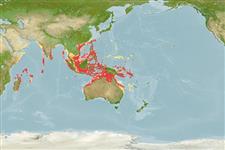
marino; salobre asociado a arrecife; rango de profundidad 1 - 85 m (Ref. 9840). Tropical; 26°N - 28°S, 44°E - 163°E
Indo-West Pacific: Red Sea to Oceania, distribution considered patchy but probably widespread.
Tamaño / Peso / Edad
Madurez: Lm ? range ? - ? cm
Max length : 141 cm WD macho / no sexado; (Ref. 58048)
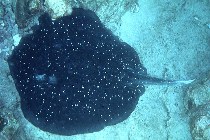
Has white spots and a white tail.
Body shape (shape guide): other.
Found in mangrove areas, also over sand or sand and rubble in lagoons near reefs to depth of 85 m on the continental shelf (Ref. 9840). Feeds on small fishes, bottom dwelling crustaceans, and large infauna (Ref. 9840). Ovoviviparous (Ref. 50449), with histotrophy. Caught regularly, but in low numbers, by demersal tangle net and bottom trawl fisheries. Utilized for its meat, skin (high value) and cartilage (Ref.58048).
Ciclo vital y comportamiento de apareamiento
Madurez | Reproducción | Puesta | Huevos | Fecundidad | Larva
Exhibit ovoviparity (aplacental viviparity), with embryos feeding initially on yolk, then receiving additional nourishment from the mother by indirect absorption of uterine fluid enriched with mucus, fat or protein through specialised structures (Ref. 50449). Distinct pairing with embrace (Ref. 205). Fully developed young, size at birth 28 cm (Ref. 37816, Ref.58048).
Last, P.R. and J.D. Stevens, 1994. Sharks and rays of Australia. CSIRO, Australia. 513 p. (Ref. 6871)
Situación en la Lista Roja de la UICN (Ref. 130435: Version 2025-2 (Global))
Amenaza para el ser humano
Traumatogenic
Usos humanos
Pesquerías: comercial
Herramientas
Informes especiales
Descargar XML
Fuentes de Internet
Estimaciones basadas en modelos
Temperatura preferida (Referencia
123201): 25.5 - 28.8, mean 27.7 °C (based on 584 cells).
Índice de diversidad filogenética (Referencia
82804): PD
50 = 0.5156 [Uniqueness, from 0.5 = low to 2.0 = high].
Bayesian length-weight: a=0.01023 (0.00482 - 0.02174), b=3.06 (2.86 - 3.26), in cm total length, based on LWR estimates for this (Sub)family-body shape (Ref.
93245).
Nivel trófico (Referencia
69278): 4.1 ±0.64 se; based on food items.
Resiliencia (Referencia
120179): Bajo, población duplicada en un tiempo mínimo de 4.5-14 años (Assuming fecundity<100).
Vulnerabilidad pesquera (Ref.
59153): Very high vulnerability (90 of 100).
🛈