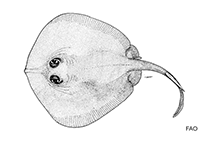
Elasmobranchii (Haie und Rochen) (sharks and rays) >
Myliobatiformes (Stingrays) >
Urolophidae (Round rays)
Etymology: Urolophus: Greek, oura = tail + Greek, lophos = crest (Ref. 45335).
More on author: Günther.
Umwelt: Milieu / Klimazone / Tiefenbereich / Verbreitungsgebiet
Ökologie
seewasser bathydemersal; tiefenbereich ? - 236 m (Ref. 9863). Deep-water
Western Central Pacific: Kei Islands, Moluccas, Indonesia.
Größe / Gewicht / Alter
Geschlechtsreife: Lm ? range ? - ? cm
Max length : 23.0 cm TL Männchen/unbestimmt; (Ref. 9863)
Rare species, known from a depth of 236 m (Ref. 9863). Maximum length based on an immature male (Ref. 9863).
Lebenszyklus und Paarungsverhalten
Geschlechtsreife | Fortpflanzung | Ablaichen | Eier | Fruchtbarkeit | Larven
Compagno, L.J.V., 1997. Urolophidae. Round rays. In K.E. Carpenter and V. Niem (eds.) FAO Identification Guide for Fishery Purposes. The Western Central Pacific. (Ref. 9863)
IUCN Rote Liste Status (Ref. 130435: Version 2025-2 (Global))
Bedrohung für Menschen
Harmless
Nutzung durch Menschen
Fischereien: nicht kommerziell
Tools
Zusatzinformationen
Download XML
Internet Quellen
Schätzungen auf der Grundlage von Modellen
Phylogenetischer Diversitätsindex (Ref.
82804): PD
50 = 0.5000 [Uniqueness, from 0.5 = low to 2.0 = high].
Bayesian length-weight: a=0.00813 (0.00371 - 0.01783), b=3.08 (2.87 - 3.29), in cm total length, based on LWR estimates for this (Sub)family-body shape (Ref.
93245).
Trophische Ebene (Ref.
69278): 3.4 ±0.4 se; based on size and trophs of closest relatives
Widerstandsfähigkeit (Ref.
120179): niedrig, Verdopplung der Population dauert 4,5 - 14 Jahre. (Assuming fecundity<100).
Anfälligkeit der Fischerei (Ref.
59153): Low vulnerability (13 of 100).
🛈