Elasmobranchii (Haie und Rochen) (sharks and rays) >
Myliobatiformes (Stingrays) >
Myliobatidae (Eagle and manta rays)
Etymology: Aetomylaeus: Greek, aetos = eagle + Greek, mylio = mill, grinder (Ref. 45335).
More on author: Gray.
Umwelt: Milieu / Klimazone / Tiefenbereich / Verbreitungsgebiet
Ökologie
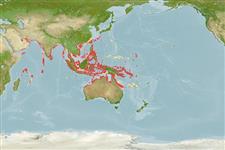
seewasser; brackwasser riff-verbunden; tiefenbereich 1 - 18 m (Ref. 37816). Tropical; 30°N - 23°S, 51°E - 167°E
Indo-West Pacific: India to China and Indonesia.
Länge bei der ersten Reifung / Größe / Gewicht / Alter
Geschlechtsreife: Lm 63.0, range 54 - 72 cm
Max length : 200 cm WD Männchen/unbestimmt; (Ref. 30573)
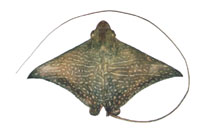
With distinctive color pattern and exceptionally long spineless tail over six times the length of the body (Ref. 37816).
Body shape (shape guide): other.
Found inshore (Ref. 9862). Inhabits mangrove creeks and protected sandy channels to a depth of at least 18 m; relatively uncommon (Ref. 37816). Active swimmer, travelling long distances; feeds on crustaceans and molluscs (Ref. 68964). Ovoviviparous (Ref. 50449). Caught occasionally by bottom trawl, tangle net and inshore gillnet fisheries. Utilized for its meat, but of limited value as it is not frequently landed (Ref. 58048). Presumably utilized for human consumption in the western central Pacific (Ref. 9862).
Lebenszyklus und Paarungsverhalten
Geschlechtsreife | Fortpflanzung | Ablaichen | Eier | Fruchtbarkeit | Larven
Exhibit ovoviparity (aplacental viviparity), with embryos feeding initially on yolk, then receiving additional nourishment from the mother by indirect absorption of uterine fluid enriched with mucus, fat or protein through specialised structures (Ref. 50449).
Mould, B., 1994. A world list of rays. The scientific nomenclature and distribution of the recent Batoidea (Batoidea, Elasmobranchii, Chondrichthyes). University of Nottingham, [UK]. 82 p. (Ref. 8630)
IUCN Rote Liste Status (Ref. 130435: Version 2025-2 (Global))
Bedrohung für Menschen
Traumatogenic
Nutzung durch Menschen
Fischereien: weniger kommerziell
Tools
Zusatzinformationen
Download XML
Internet Quellen
Schätzungen auf der Grundlage von Modellen
Bevorzugte Temperatur (Ref.
123201): 25.6 - 29.3, mean 28.6 °C (based on 2218 cells).
Phylogenetischer Diversitätsindex (Ref.
82804): PD
50 = 0.5039 [Uniqueness, from 0.5 = low to 2.0 = high].
Bayesian length-weight: a=0.00389 (0.00124 - 0.01219), b=3.08 (2.83 - 3.33), in cm total length, based on LWR estimates for this (Sub)family-body shape (Ref.
93245).
Trophische Ebene (Ref.
69278): 3.8 ±0.5 se; based on size and trophs of closest relatives
Widerstandsfähigkeit (Ref.
120179): niedrig, Verdopplung der Population dauert 4,5 - 14 Jahre. (Fec assumed to be <100).
Anfälligkeit der Fischerei (Ref.
59153): Very high vulnerability (83 of 100).
🛈