Elasmobranchii (tubarões e raias) (sharks and rays) >
Myliobatiformes (Stingrays) >
Aetobatidae (Pacific eagle rays)
Etymology: Aetobatus: Greek, aetos = eagle + Greek, batis, batidos = a ray (Raja sp.) (Ref. 45335).
More on author: Kuhl.
Ambiente: milieu / zona climática / intervalo de profundidade / gama de distribuição
Ecologia
marinhas; estuarina bentopelágico; intervalo de profundidade 1 - 100 m (Ref. 89467), usually 20 - 25 m (Ref. 89467). Tropical
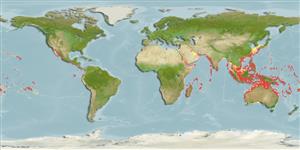
Indo-West Pacific: East Africa, including the Red Sea to Hawaiian Islands and French Polynesia.
Comprimento na primeira maturidade / Tamanho / Peso / Idade
Maturidade: Lm 155.0, range 150 - 160 cm
Max length : 300 cm WD macho/indeterminado; (Ref. 114953); common length : 180 cm WD macho/indeterminado; (Ref. 6871); peso máx. Publicado: 200.0 kg (Ref. 89467)
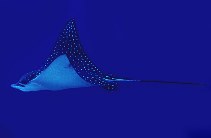
This large species is distinguished by the following characters: dorsal surfaces with a dark greenish grey base coloration, variably white spotted, rarely ocellated; different NADH2 gene structure; relatively long tail with mean total length 281% DW, mean anterior cloaca to tail tip 230.2% DW; stinging spines relatively long with mean length of first spine 9.7%DW; teeth plates are in a single row, those in the lower jaw chevron-shaped; pectoral fin radials about 102-116, excluding proterygial radials anterior of eyes; 99-101 total vertebral centra, including synarcual (Ref. 84291).
Body shape (shape guide): other; Cross section: flattened.
Found in coastal waters (Ref. 45255), including estuarine habitats (Ref. 89467). Can grow over 3 m disc width and up to 880 cm total length if the long tail is undamaged (Ref. 30573). Feeds mainly on hard-shelled bottom-dwelling invertebrates such as hermit crabs, whelks, oysters, clams and large molluscs (Ref. 9862, 114953), crustraceans, worms, octopuses and fishes (Ref. 89467). Ovoviviparous (Ref. 50449). Size at maturity for males 100-130 cm WD, females ca. 150-160 cm WD and size at birth highly variable 18 cm to at least 50 cm WD. Females produce litters up to 10 pups, usually 4 or less (Ref. 114953). Common catch of the demersal tangle net, bottom trawl, inshore gillnet and, to a lesser extent, demersal longline fisheries. Utilized for its meat and cartilage (Ref. 58048). Tail used as a decorative item (Ref. 27550). Flesh edible (Ref. 30573).
Ciclo de vida e comportamento de acasalamento
Maturidade | Reprodução | Desova | Ovos | Fecundidade | Larvas
Exhibit ovoviparity (aplacental viviparity), with embryos feeding initially on yolk, then receiving additional nourishment from the mother by indirect absorption of uterine fluid enriched with mucus, fat or protein through specialised structures (Ref. 50449).
White, W.T., P.R. Last, G.J.P. Naylor, K. Jensen and J.N. Caira, 2010. Clarification of Aetobatus ocellatus (Kuhl, 1823) as a valid species, and a comparison with Aetobatus narinari (Euphrasen, 1790) (Rajiformes: Myliobatidae). pp. 141-164. In P.R. Last, W.T. White and J.J. Pogonoski (eds). Descriptions of new sharks and rays from Borneo. CSIRO Marine and Atmospheric Research Paper no. 32. (Ref. 84291)
Categoria na Lista Vermelha da IUCN (Ref. 130435: Version 2025-2 (Global))
Ameaça para o homem
Traumatogenic (Ref. 4690)
Utilização humana
Pescarias: espécies comerciais; peixe desportivo: sim
Ferramentas
Relatórios especiais
Descarregue XML
Fontes da internet
Estimativas baseadas em modelos
Temperatura preferida (Ref.
123201): 24.8 - 29, mean 28 °C (based on 194 cells).
Índice de diversidade filogenética (Ref.
82804): PD
50 = 0.5625 [Uniqueness, from 0.5 = low to 2.0 = high].
Bayesian length-weight: a=0.01000 (0.00244 - 0.04107), b=3.04 (2.81 - 3.27), in cm total length, based on all LWR estimates for this body shape (Ref.
93245).
Nível Trófico (Ref.
69278): 3.6 ±0.5 se; based on size and trophs of closest relatives
Resiliência (Ref.
120179): Baixo, tempo mínimo de duplicação da população 4,5 - 14 anos (Fec assumed to be <100).
Vulnerabilidade da pesca (Ref.
59153): Very high vulnerability (83 of 100).
🛈
Nutrientes (Ref.
124155): Calcium = 11.2 [3.0, 58.1] mg/100g; Iron = 0.462 [0.106, 1.292] mg/100g; Protein = 21.2 [16.0, 26.3] %; Omega3 = 0.154 [0.046, 0.481] g/100g; Selenium = 63 [18, 210] μg/100g; VitaminA = 11.9 [4.0, 34.7] μg/100g; Zinc = 0.796 [0.376, 1.528] mg/100g (wet weight);