>
Mulliformes (Goatfishes) >
Mullidae (Goatfishes)
Etymology: Parupeneus: Latin, parum, parvum = small + Peneus, the name of a river.
Taxonomic Remarks
FishBase common name coined in Uiblein et al. (2024: Ref. 130857). Whitesaddle goatfish was previously used for Parupeneus ciliatus.
Milieu: milieu / Klimaatzone / Diepte / verspreidingsgebied
Ecologie
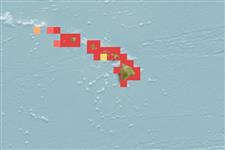
marien rifbewoner; diepte 1 - 140 m (Ref. 9710). Tropical; 24°N - 18°N, 164°W - 153°W
Eastern Central Pacific: Hawaii.
Lengte bij maturiteit / Grootte / Gewicht / Leeftijd
Maturiteit: Lm ?, range 26 - ? cm
Max length : 51.0 cm TL mannelijk / geslacht onbekend; (Ref. 54393)
Korte beschrijving
Determinatiesleutels | Morfologie | Morfometrie
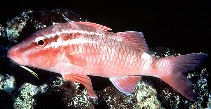
Dorsale stekels (totaal) : 8; Dorsale zachte stralen (totaal) : 9; Anale zachte stralen: 7; Wervels: 24. Diagnosis: Pectoral rays 15 (rarely 14 or 16). Gill rakers 6-7 + 24-27 (total 30-34). Body depth 2.85-3.25 in SL; head length (HL) 2.85-3.1 in SL; snout length 1.85-2.2 in HL; barbels short, 1.65-1.95 in HL; longest dorsal spine 1.55-1.85 in HL; last dorsal ray slightly longer than penultimate ray; posterior margin of each caudal lobe convex; pectoral-fin length 1.3-1.5 in HL; pelvic-fin length 1.2-1.4 in HL. Body red to reddish brown dorsally, light red ventrally, with a white saddle-like spot on caudal peduncle flanked anteriorly and posteriorly by a dusky spot, the posterior one darkest; a reddish brown band from front of snout through eye and along body to above lateral line, fading and broadening below second dorsal fin, dark band behind eye and anteriorly on body bordered by a white band; fins mainly red; barbels white (Ref. 54393).
Body shape (shape guide): fusiform / normal.
Inhabits lagoon and seaward reefs; in small groups under ledges or among corals by day, dispersing at night to feed among rocks and corals on benthic crustaceans (Ref. 9710). It is a nocturnal predator that feeds mostly on benthic crustaceans (Ref. 13550). Spawning appears to be year-round with the peak from December to July; females may spawn more than once a year (Ref. 54393).
Levenscyclus en paargedrag
Maturiteit | Voortplanting | Paaien | Eieren | Fecunditeit | Larven
Randall, J.E., 2004. Revision of the goatfish genus Parupeneus (Perciformes: Mullidae), with descriptions of two new species. Indo-Pac. Fish. (36):64 p. (Ref. 54393)
Status op de Rode Lijst van het IUCN (Ref. 130435: Version 2025-2 (Global))
Gevaar voor de mens
Harmless
Gebruik door de mens
Visserij: commercieel
Tools
Speciale rapporten
Download XML
Internetbronnen
Schattingen op basis van modellen
Gewenste temperatuur (Ref.
123201): 8.9 - 25.5, mean 20.3 °C (based on 8 cells).
Fylogenetische diversiteitsindex (Ref.
82804): PD
50 = 0.5000 [Uniqueness, from 0.5 = low to 2.0 = high].
Bayesian length-weight: a=0.02399 (0.01203 - 0.04785), b=3.20 (3.04 - 3.36), in cm total length, based on LWR estimates for this species & Genus-body shape (Ref.
93245).
Trofisch niveau (Ref.
69278): 4.0 ±0.60 se; based on food items.
Generation time: 2.0 ( na - na) years. Estimated as median ln(3)/K based on 1
growth studies.
Weerstandsvermogen (Ref.
120179): Gemiddeld, minimale populatieverdubbelingstijd 1,4-4,4 jaar (K=0.5; tm=1).
Kwetsbaarheid van de visserij (Ref.
59153): Low to moderate vulnerability (27 of 100).
🛈
Voedingsstoffen (Ref.
124155): Calcium = 27.7 [13.3, 62.8] mg/100g; Iron = 0.303 [0.148, 0.682] mg/100g; Protein = 18.2 [14.9, 21.2] %; Omega3 = 0.139 [0.076, 0.264] g/100g; Selenium = 71.5 [33.1, 172.0] μg/100g; VitaminA = 137 [27, 604] μg/100g; Zinc = 0.409 [0.241, 0.803] mg/100g (wet weight);