>
Perciformes/Serranoidei (Groupers) >
Liopropomatidae (Painted basslets) > Diploprioninae
Etymology: Belonoperca: Greek, belone = needle; any fish with sharp pointed snout; also Pierre Belon, 1517-64, French zoologist born in Le Mans. Professor at the College de France, author of " La nature et diversité des poissons", 1551 + Greek, perke = perch (Ref. 45335).
Eponymy: Dr Paul Chabanaud (1876–1959) was a French ichthyologist and herpetologist. [...] (Ref. 128868), visit book page.
More on authors: Fowler & Bean.
Environnement : milieu / zone climatique / profondeur / gamme de distribution
Écologie
marin récifal; profondeur 4 - 50 m (Ref. 9710). Tropical; 30°N - 23°S
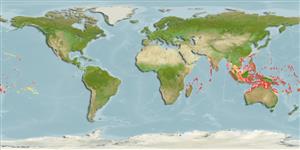
Indo-Pacific: East Africa to Samoa, north to the Ryukyu Islands, south to New Caledonia.
Taille / Poids / Âge
Maturité: Lm ? range ? - ? cm
Max length : 15.0 cm TL mâle / non sexé; (Ref. 9710)
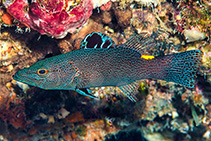
Épines dorsales (Total) : 9; Rayons mous dorsaux (Total) : 10; Épines anales: 2; Rayons mous anaux: 8. Body brown in color (may also be dusky bluish grey to almost black (Ref. 48635)), caudal peduncle with saddle-like yellow spot; large ocellated black spot on spinous dorsal (Ref. 4326).
Body shape (shape guide): elongated; Cross section: compressed.
Occurs in steep slopes of coral rich areas. Usually hovers in mid water in caves (Ref. 9710). Nocturnal species (Ref. 4326). Secretive and solitary (Ref. 37816). Feeds on small fishes and crustaceans (Ref. 89972). Easily missed and normally the yellow spot is noticed first (Ref. 48635). Produces the skin toxin grammistin.
Cycle de vie et comportement reproducteur
Maturité | Reproduction | Frai | Œufs | Fécondité | Larves
Randall, J.E., G.R. Allen and R.C. Steene, 1990. Fishes of the Great Barrier Reef and Coral Sea. University of Hawaii Press, Honolulu, Hawaii. 506 p. (Ref. 2334)
Statut dans la liste rouge de l'IUCN (Ref. 130435: Version 2025-2 (Global))
Menace pour l'homme
Harmless
Utilisations par l'homme
Outils
Articles particuliers
Télécharger en XML
Sources Internet
Estimations basées sur des modèles
Température préférée (Réf.
123201): 25.8 - 28.8, mean 27.6 °C (based on 426 cells).
Indice de diversité phylogénétique (Réf.
82804): PD
50 = 0.7500 [Uniqueness, from 0.5 = low to 2.0 = high].
Bayesian length-weight: a=0.00389 (0.00180 - 0.00842), b=3.12 (2.94 - 3.30), in cm total length, based on all LWR estimates for this body shape (Ref.
93245).
Niveau trophique (Réf.
69278): 4.0 ±0.67 se; based on food items.
Vulnérabilité de la pêche (Ref.
59153): Low vulnerability (10 of 100).
🛈
Nutriments (Ref.
124155): Calcium = 84 [48, 177] mg/100g; Iron = 0.642 [0.326, 1.169] mg/100g; Protein = 18 [16, 20] %; Omega3 = 0.115 [0.065, 0.210] g/100g; Selenium = 29.4 [14.0, 62.4] μg/100g; VitaminA = 140 [42, 500] μg/100g; Zinc = 1.42 [0.90, 2.14] mg/100g (wet weight);