Ambiente: milieu / zona climatica / distribuzione batimetrica / gamma di distribuzione
Ecologia
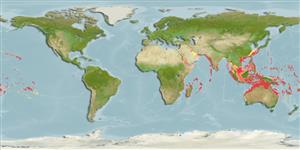
marino; salmastro associati a barriera corallina; distribuzione batimetrica 0 - 150 m (Ref. 30573), usually 10 - 137 m (Ref. 27115). Tropical; 25°C - 28°C (Ref. 27115); 31°N - 32°S, 30°E - 122°W (Ref. 57251)
Indo-Pacific: Red Sea and East Africa (Ref. 9710), including the Mascarene Islands (Ref. 37792) to the Hawaiian, Marquesas and Ducie islands, north to southern Japan, south to Lord Howe Island.
Lunghezza alla prima maturità / Dimensione / Peso / Età
Maturità: Lm 45.0 range ? - ? cm
Max length : 75.0 cm FL maschio/sesso non determinato; (Ref. 1602); common length : 50.0 cm TL maschio/sesso non determinato; (Ref. 30573); Età massima riportata: 44 anni (Ref. 52229)
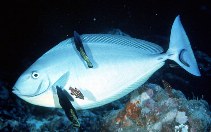
Spine dorsali (totale) : 6; Raggi dorsali molli (totale) : 26 - 29; Spine anali: 2; Raggi anali molli: 27 - 30. This species is distinguished by the following characters: body moderately deep and compressed, its depth 2.6 to 3.2 times in standard length (SL); dorsal profile of body uniformly convex, without any bony horn-like projection or protuberance anteriorly on head; mouth small; incisiform teeth very small, somewhat pointed, finely serrate on edges, as many as 80 in upper jaw and 100 in lower jaw of large adults; continuous unnotched D VI (rarely V or VII),26-29; A II,27-30; pectoral-fin rays 17-18 (usually 17); pelvic fins I,3; caudal fin slightly emarginate in young, becoming truncate in adults; caudal peduncle slender, subcylindrical, with a pair of bony plates on each side that develop large sharp antrorse keels with age; body colour dark brownish grey, shading ventrally to yellowish (life colour may vary from dark brown to light blue-grey); edge of operculum and preopercle usually dark brown; dorsal and anal fins yellowish with faint diagonal brown bands and a blue margin; tongue black at lengths of 25 cm or more (Ref. 9808).
Body shape (shape guide): fusiform / normal; Cross section: compressed.
Inhabits clear lagoon and seaward reef slopes (Ref. 9710, 48637). Benthopelagic (Ref. 58302). Usually seen in large schools (Ref. 90102). Mainly diurnal, it feeds on zooplankton such as crab larvae, arrow worms, pelagic tunicates, and occasionally filamentous red algae. The species is never poisonous (Ref. 4795). Minimum depth reported taken from Ref. 128797.
Ciclo vitale e comportamento di accoppiamento
Maturità | Riproduzione | Deposizione | Uova | Fecondità | Larve
Spawn in pairs (Ref. 240).
Myers, R.F., 1991. Micronesian reef fishes. Second Ed. Coral Graphics, Barrigada, Guam. 298 p. (Ref. 1602)
Stato della Lista Rossa IUCN (Ref. 130435: Version 2025-2 (Global))
Usi umani
Pesca: commerciale; Pesce da pesca sportiva: si; Acquario: Commerciale
Strumenti
Rapporti speciali
Scarica XML
Fonti Internet
Stime basate su modelli
Temperatura preferita (Fonte Biblio.
123201): 22.1 - 28.9, mean 27.5 °C (based on 2224 cells).
Indice di diversità filogenetica (Fonte Biblio.
82804): PD
50 = 0.5000 [Uniqueness, from 0.5 = low to 2.0 = high].
Bayesian length-weight: a=0.02344 (0.01427 - 0.03851), b=2.95 (2.81 - 3.09), in cm total length, based on LWR estimates for this species & Genus-body shape (Ref.
93245).
Livello trofico (Fonte Biblio.
69278): 3.1 ±0.33 se; based on food items.
Generation time: 5.0 ( na - na) years. Estimated as median ln(3)/K based on 1
growth studies.
Resilienza (Fonte Biblio.
120179): Molto basso, tempo minimo di raddoppiamento della popolazione più di 14 anni (tm=7; K=0.221; tmax=44;).
Vulnerabilità della pesca (Ref.
59153): Moderate vulnerability (42 of 100).
🛈
Nutrienti (Ref.
124155): Calcium = 26.9 [15.5, 50.5] mg/100g; Iron = 0.53 [0.26, 0.94] mg/100g; Protein = 19.1 [18.0, 20.1] %; Omega3 = 0.152 [0.094, 0.288] g/100g; Selenium = 43 [22, 76] μg/100g; VitaminA = 73 [25, 209] μg/100g; Zinc = 1.14 [0.78, 1.63] mg/100g (wet weight);