>
Blenniiformes (Blennies) >
Blenniidae (Combtooth blennies) > Salariinae
Etymology: Ecsenius: Greek, exenios, -os, -on = uncontrolled, immoderate.
Umwelt: Milieu / Klimazone / Tiefenbereich / Verbreitungsgebiet
Ökologie
seewasser riff-verbunden; standorttreu; tiefenbereich 2 - 10 m (Ref. 90102). Tropical
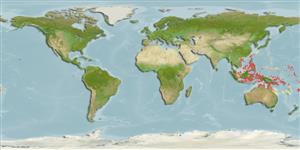
Western Central Pacific: known only from the small islands in the Moluccas, New Guinea and eastward to Florida Island, Solomon Islands.
Größe / Gewicht / Alter
Geschlechtsreife: Lm ? range ? - ? cm
Max length : 3.0 cm TL Männchen/unbestimmt; (Ref. 48636)
Kurzbeschreibung
Bestimmungsschlüssel | Morphologie | Morphometrie
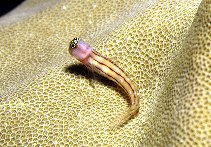
Distinctive species, easily identified by the thin dark lines and bright white spots. The Bali specimens are generally paler and have smaller white spots than those from Flores and Sangihe Islands but this maybe habitat related (Ref. 48636).
Body shape (shape guide): elongated.
Adults are found solitary or in small groups perched on corals, sponges, and tunicates (Ref. 90102) in coastal reef crests (Ref. 8631, 48636). Oviparous. Eggs are demersal and adhesive (Ref. 205), and are attached to the substrate via a filamentous, adhesive pad or pedestal (Ref. 94114). Larvae are planktonic, often found in shallow, coastal waters (Ref. 94114).
Lebenszyklus und Paarungsverhalten
Geschlechtsreife | Fortpflanzung | Ablaichen | Eier | Fruchtbarkeit | Larven
Oviparous, distinct pairing (Ref. 205).
Springer, V.G., 1988. The Indo-Pacific blenniid fish genus Ecsenius. Smithson. Contrib. Zool. (465):134 p. (Ref. 5296)
IUCN Rote Liste Status (Ref. 130435: Version 2025-2 (Global))
Bedrohung für Menschen
Harmless
Nutzung durch Menschen
Fischereien: nicht kommerziell; Aquarium: Kommerziell
Tools
Zusatzinformationen
Download XML
Internet Quellen
Schätzungen auf der Grundlage von Modellen
Bevorzugte Temperatur (Ref.
123201): 27.1 - 29.3, mean 28.8 °C (based on 1271 cells).
Phylogenetischer Diversitätsindex (Ref.
82804): PD
50 = 0.5000 [Uniqueness, from 0.5 = low to 2.0 = high].
Bayesian length-weight: a=0.00776 (0.00354 - 0.01702), b=3.00 (2.81 - 3.19), in cm total length, based on LWR estimates for this (Sub)family-body shape (Ref.
93245).
Trophische Ebene (Ref.
69278): 2.0 ±0.00 se; based on food items.
Widerstandsfähigkeit (Ref.
120179): hoch, Verdopplung der Population dauert weniger als 15 Monate. (Preliminary K or Fecundity.).
Anfälligkeit der Fischerei (Ref.
59153): Low vulnerability (10 of 100).
🛈
Nährstoffe (Ref.
124155): Calcium = 423 [193, 1,079] mg/100g; Iron = 1.63 [0.79, 3.33] mg/100g; Protein = 17.6 [16.2, 19.0] %; Omega3 = 0.0894 [, ] g/100g; Selenium = 29.9 [9.7, 86.2] μg/100g; VitaminA = 98 [19, 511] μg/100g; Zinc = 5.25 [2.92, 8.46] mg/100g (wet weight);