>
Eupercaria/misc (Various families in series Eupercaria) >
Labridae (Wrasses) > Julidinae
Etymology: Halichoeres: Greek, als, alis = salt + Greek, choiros = pig (Ref. 45335).
More on author: Lacepède.
Milieu: milieu / Klimaatzone / Diepte / verspreidingsgebied
Ecologie
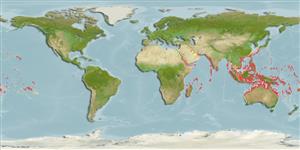
marien rifbewoner; diepte 0 - 40 m (Ref. 128797), usually 1 - 30 m (Ref. 27115). Tropical; 24°C - 28°C (Ref. 27115); 32°N - 28°S, 34°E - 134°W
Indo-Pacific: Red Sea south to Sodwana Bay, South Africa and east to the Line, Marquesas and Tuamoto islands, north to southern Japan, south to the southern Great Barrier Reef.
Lengte bij maturiteit / Grootte / Gewicht / Leeftijd
Maturiteit: Lm 12.8 range ? - ? cm
Max length : 27.0 cm TL mannelijk / geslacht onbekend; (Ref. 2334)
Korte beschrijving
Determinatiesleutels | Morfologie | Morfometrie
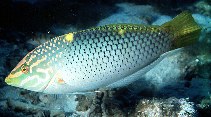
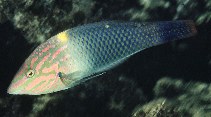
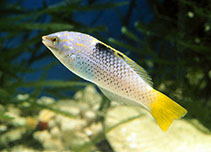
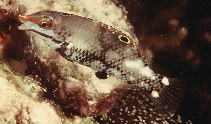
Dorsale stekels (totaal) : 9; Dorsale zachte stralen (totaal) : 11; Anale stekels: 3; Anale zachte stralen: 11. Some geographical variations between Indian and Pacific Ocean and Red Sea. Adults with one or two yellow saddles over the back and sometimes with small black spot on upper peduncle. Small juveniles black and white, gradually changing with growth to adult pattern (Ref. 48636).
Body shape (shape guide): fusiform / normal; Cross section: compressed.
Inhabits sand patches of lagoon and seaward reefs to at least 30 m (Ref. 1602); also on slopes to moderate depths along drop-offs (Ref. 48636). Juveniles common at the bottom of surge channels (Ref. 9710). Feeds mainly on hard-shelled prey, including mollusks, crustaceans and sea urchins (9823).
Levenscyclus en paargedrag
Maturiteit | Voortplanting | Paaien | Eieren | Fecunditeit | Larven
Distinct pairing during breeding (Ref. 205).
Randall, J.E., G.R. Allen and R.C. Steene, 1990. Fishes of the Great Barrier Reef and Coral Sea. University of Hawaii Press, Honolulu, Hawaii. 506 p. (Ref. 2334)
Status op de Rode Lijst van het IUCN (Ref. 130435: Version 2025-2 (Global))
Gevaar voor de mens
Harmless
Gebruik door de mens
Visserij: van minder commercieel belang; Aquarium: Commercieel
Tools
Speciale rapporten
Download XML
Internetbronnen
Schattingen op basis van modellen
Gewenste temperatuur (Ref.
123201): 24.8 - 29, mean 27.6 °C (based on 978 cells).
Fylogenetische diversiteitsindex (Ref.
82804): PD
50 = 0.5000 [Uniqueness, from 0.5 = low to 2.0 = high].
Bayesian length-weight: a=0.00955 (0.00553 - 0.01649), b=3.08 (2.93 - 3.23), in cm total length, based on LWR estimates for this species & Genus-body shape (Ref.
93245).
Trofisch niveau (Ref.
69278): 3.4 ±0.42 se; based on food items.
Generation time: 1.5 ( na - na) years. Estimated as median ln(3)/K based on 1
growth studies.
Weerstandsvermogen (Ref.
120179): Hoog, minimale populatieverdubbelingstijd minder dan 15 maanden (K=0.7).
Kwetsbaarheid van de visserij (Ref.
59153): Low vulnerability (21 of 100).
🛈
Voedingsstoffen (Ref.
124155): Calcium = 72.3 [43.5, 119.1] mg/100g; Iron = 0.742 [0.433, 1.311] mg/100g; Protein = 18.7 [15.8, 20.9] %; Omega3 = 0.145 [0.096, 0.223] g/100g; Selenium = 30 [19, 52] μg/100g; VitaminA = 77.2 [25.7, 278.1] μg/100g; Zinc = 1.44 [1.02, 2.23] mg/100g (wet weight);