>
Eupercaria/misc (Various families in series Eupercaria) >
Labridae (Wrasses) > Hypsigenyinae
Etymology: Bodianus: Bodianus after Bodiano or Pudiano, from the Portuguese pudor, meaning modesty (Jordan & Evermann, 1896); loxozonus: Name from Greek loxos for slanting, and feminine noun zone or belt, referring to the prominent black oblique band posteriorly on the body of adults of this species (Ref. 75973).
More on author: Snyder.
Umwelt: Milieu / Klimazone / Tiefenbereich / Verbreitungsgebiet
Ökologie
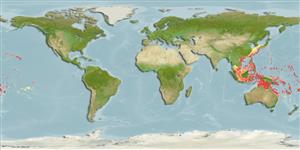
seewasser riff-verbunden; tiefenbereich 3 - 100 m (Ref. 9823), usually 3 - 40 m (Ref. 27115). Tropical; 25°C - 28°C (Ref. 27115); 37°N - 35°S, 101°E - 130°W
Western Pacific: eastward to French Polynesia, north to Japan, south to New Caledonia. Myers & Lieske 1994 (Ref. 9710) list the subspecies loxozonus as occurring from Vietnam to the Marshall Islands and Tonga, north to the Ryukyu and Ogasawara Islands and the subspecies trotteri as occurring in the Line and Cook Islands and French Polynesia. Reports of Bodianus hirsutus (synonym of Bodianus macrourus) from SW Indian Ocean may be referring to this species.
Größe / Gewicht / Alter
Geschlechtsreife: Lm ? range ? - ? cm
Max length : 47.0 cm TL Männchen/unbestimmt; (Ref. 9710)
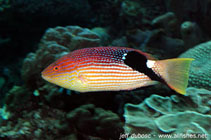
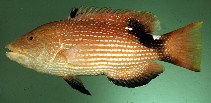
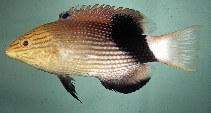
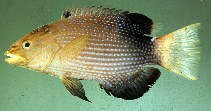
Rückenflossenstacheln (insgesamt) : 12; Rückenflossenweichstrahlen (insgesamt) : 9 - 11; Afterflossenstacheln: 3; Afterflossenweichstrahlen: 11 - 12. Adults usually with a large black blotch on the back, extending along the lower lobe of the tail fin to the black ventral fins, but reduced to a small patch in large males (Ref. 48636). Often misidentified as Bodianus hirsutus (synonym of Bodianus macrourus (Lacepede, 1801) (Ref. 54980).
Body shape (shape guide): fusiform / normal; Cross section: compressed.
Adults inhabit clear lagoon and seaward reefs (Ref. 1602), on slopes or along upper part of drop-offs (Ref. 48636). Feed mainly on benthic, hard-shelled, invertebrates such as mollusks and crustaceans (Ref. 9823). Oviparous, distinct pairing during breeding (Ref. 205).
Lebenszyklus und Paarungsverhalten
Geschlechtsreife | Fortpflanzung | Ablaichen | Eier | Fruchtbarkeit | Larven
Oviparous, distinct pairing during breeding (Ref. 205).
Gomon, M.F., 2006. A revision of the labrid fish genus Bodianus with descriptions of eight new species. Rec. Aust. Mus. Suppl. 30:1-133. (Ref. 75973)
IUCN Rote Liste Status (Ref. 130435: Version 2025-2 (Global))
Bedrohung für Menschen
Harmless
Nutzung durch Menschen
Fischereien: weniger kommerziell; Aquarium: Kommerziell
Tools
Zusatzinformationen
Download XML
Internet Quellen
Schätzungen auf der Grundlage von Modellen
Bevorzugte Temperatur (Ref.
123201): 24.6 - 28.8, mean 27.6 °C (based on 668 cells).
Phylogenetischer Diversitätsindex (Ref.
82804): PD
50 = 0.5000 [Uniqueness, from 0.5 = low to 2.0 = high].
Bayesian length-weight: a=0.01047 (0.00493 - 0.02225), b=3.08 (2.90 - 3.26), in cm total length, based on LWR estimates for this Genus-body shape (Ref.
93245).
Trophische Ebene (Ref.
69278): 3.6 ±0.50 se; based on food items.
Widerstandsfähigkeit (Ref.
120179): mittel, Verdopplung der Population dauert 1,4 - 4,4 Jahre. (Preliminary K or Fecundity.).
Anfälligkeit der Fischerei (Ref.
59153): Moderate vulnerability (37 of 100).
🛈
Nährstoffe (Ref.
124155): Calcium = 37.3 [22.8, 58.4] mg/100g; Iron = 0.524 [0.314, 0.921] mg/100g; Protein = 18.6 [15.7, 20.8] %; Omega3 = 0.145 [0.100, 0.211] g/100g; Selenium = 37.8 [23.9, 61.9] μg/100g; VitaminA = 92.5 [30.2, 316.1] μg/100g; Zinc = 1.2 [0.9, 1.8] mg/100g (wet weight);