>
Kurtiformes (Nurseryfishes, cardinalfishes.) >
Apogonidae (Cardinalfishes) > Apogoninae
Etymology: Fibramia: Latin 'fibra' meaning thread or filament and the feminine Greek 'amia' often applied as an ending for some cardinalfish genera as well as an incorrect past usage as a cardinalfish genus. The name refers to two characteristics of the species in this genus, an elongate second dorsal spine in one species and the narrow, pale or dark mid-line on the body of two species.
More on author: Cuvier.
Περιβάλλον: περιβάλλον / κλιματική ζώνη / εύρος βάθους / εύρος διανομής
Οικολογία
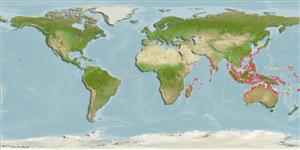
Θαλασσινό(ά) Υφαλόφιλο(α); μη μεταναστευτικό(ά); εύρος βάθους 0 - 20 m (Ref. 48635), usually 0 - 12 m (Ref. 90102). Tropical
Indo-Pacific: south to Natal, South Africa (Ref. 4329) and east to western Pacific.
Μέγεθος / Βάρος / Ηλικία
Γεννητική Ωρίμανση: Lm ? range ? - ? cm
Max length : 8.5 cm TL αρσενικό/απροσδιόριστο; (Ref. 90102)
Σύντομη περιγραφή
Κλείδες προσδιορισμού | Μορφολογία | Μορφομετρία
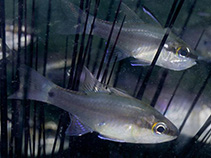
Ραχιαίες άκανθες (συνολικά) : 7; Μαλακές ραχιαίες ακτίνες (συνολικά) : 9; Εδρικές άκανθες: 2; Μαλακές εδρικές ακτίνες: 8. Black stripe from snout through eye to angle of opercle; tip of 1st dorsal present; caudal spot present (Ref. 4329, 48635). Sometimes has yellow barring on sides (Ref. 48635). 2-3 tiny black spots along base of dorsal fin; greatest depth of body 2.6-3.0 in SL (Ref. 90102).
Body shape (shape guide): elongated; Cross section: compressed.
Found in deep coastal reefs (Ref. 8631). Form small schools with outcrops on reef on sand to depths of 20 m (Ref. 48635); or among rocks or corals of shallow sheltered lagoons (Ref. 7300); often in seagrass beds (Ref. 37816). A nocturnal species (Ref. 7300).
Κύκλος ζωής και συμπεριφορά ζευγαρώματος
Γεννητική Ωρίμανση | Αναπαραγωγή | Γεννοβολία | Αβγά | Γονιμότητα | Προνύμφες
Mouthbrooders (Ref. 240). Distinct pairing during courtship and spawning (Ref. 205).
Kailola, P.J., 1991. The fishes of Papua New Guinea: a revised and annotated checklist. Vol. III. Gobiidae to Molidae. Research Bulletin No. 41, Research Section, Dept. of Fisheries and Marine Resources, Papua New Guinea. 153 p. (Ref. 6771)
Κατάσταση Κόκκινου Καταλόγου IUCN (Ref. 130435: Version 2025-2 (Global))
Απειλή για τον άνθρωπο
Harmless
Ανθρώπινες χρήσεις
αλιεία: περιορισμένης εμπορικότητας; Ενυδρείο: Εμπορικό(ά)
Εργαλεία
Ειδικές εκθέσεις
Λήψη XML
Διαδικτυακές πηγές
Εκτιμήσεις βάσει μοντέλων
Προτιμώμενη θερμοκρασία (Αναφ.
123201): 24.9 - 29.3, mean 28.5 °C (based on 2879 cells).
Δείκτης φυλογενετικής ποικιλότητας (Αναφ.
82804): PD
50 = 0.6250 [Uniqueness, from 0.5 = low to 2.0 = high].
Bayesian length-weight: a=0.00692 (0.00302 - 0.01587), b=3.22 (3.02 - 3.42), in cm total length, based on LWR estimates for this (Sub)family-body shape (Ref.
93245).
Τροφικό Επίπεδο (Αναφ.
69278): 3.5 ±0.50 se; based on food items.
Ελαστικότητα (Αναφ.
120179): Υψηλό, ελάχιστος χρόνος για διπλασιασμό πληθυσμού < 15 μήνες (Preliminary K or Fecundity.).
Ευπάθεια στην αλιεία (Ref.
59153): Low vulnerability (10 of 100).
🛈
Θρεπτικά συστατικά (Ref.
124155): Calcium = 202 [104, 376] mg/100g; Iron = 1.09 [0.59, 1.88] mg/100g; Protein = 18.5 [17.4, 19.7] %; Omega3 = 0.103 [0.055, 0.201] g/100g; Selenium = 32.3 [14.1, 73.2] μg/100g; VitaminA = 81.2 [24.5, 255.6] μg/100g; Zinc = 2.32 [1.45, 3.50] mg/100g (wet weight);