>
Eupercaria/misc (Various families in series Eupercaria) >
Labridae (Wrasses) > Pseudolabrinae
Etymology: Pseudolabrus: Greek, pseudes = false + Greek, labrax = a fish, Dicentrarchus labrax (Ref. 45335); japonicus: Specific epithet refers to the country of origin of Houttuyn's type specimens.
Umwelt: Milieu / Klimazone / Tiefenbereich / Verbreitungsgebiet
Ökologie
seewasser riff-verbunden. Tropical
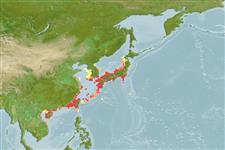
Northwest Pacific: central Honshu to Okinawajima in Japan; South Korea, southern China, Taiwan, and Hong Kong.
Größe / Gewicht / Alter
Geschlechtsreife: Lm ? range ? - ? cm
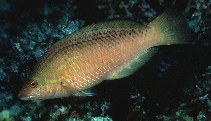
Max length : 25.0 cm TL Männchen/unbestimmt; (Ref. 559)
Retires under low rock ledges at night. Feeds mainly on small benthic organisms (small crustaceans, mollusks and polychaete worms, sponges, coral polyps). Hibernates in the sand in winter.
Lebenszyklus und Paarungsverhalten
Geschlechtsreife | Fortpflanzung | Ablaichen | Eier | Fruchtbarkeit | Larven
Pelagic spawner.
Russell, B.C., 1988. Revision of the labrid fish genus Pseudolabrus and allied genera. Rec. Aust. Mus. (Suppl. 9):1-72. (Ref. 26203)
IUCN Rote Liste Status (Ref. 130435: Version 2025-2 (Global))
Bedrohung für Menschen
Harmless
Nutzung durch Menschen
Fischereien: kommerziell; Aquarium: Kommerziell
Tools
Zusatzinformationen
Download XML
Internet Quellen
Schätzungen auf der Grundlage von Modellen
Bevorzugte Temperatur (Ref.
123201): 17.6 - 26.9, mean 22.8 °C (based on 267 cells).
Phylogenetischer Diversitätsindex (Ref.
82804): PD
50 = 0.5002 [Uniqueness, from 0.5 = low to 2.0 = high].
Bayesian length-weight: a=0.01778 (0.00686 - 0.04609), b=3.02 (2.79 - 3.25), in cm total length, based on LWR estimates for this (Sub)family-body shape (Ref.
93245).
Trophische Ebene (Ref.
69278): 3.1 ±0.35 se; based on food items.
Widerstandsfähigkeit (Ref.
120179): mittel, Verdopplung der Population dauert 1,4 - 4,4 Jahre. (Preliminary K or Fecundity.).
Anfälligkeit der Fischerei (Ref.
59153): Low vulnerability (15 of 100).
🛈