>
Scombriformes (Mackerels) >
Trichiuridae (Cutlassfishes) > Trichiurinae
Etymology: Trichiurus: Greek, thrix = hair + Greek, oura = tail (Ref. 45335); lepturus: Specific name from Greek 'lepturus', for its thin or slender tail.
More on author: Linnaeus.
Entorno: milieu / zona climática / rango de profundidad / gama de distribución
Ecología
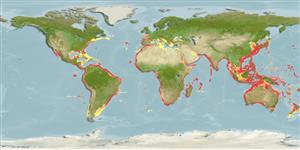
marino; salobre bentopelágico; anfidromo (Ref. 51243); rango de profundidad 0 - 589 m (Ref. 58018), usually 100 - 350 m (Ref. 35388). Subtropical; 49°N - 54°S, 114°W - 180°E (Ref. 54931)
Circumtropical and Circumtemperate: including Gulf of Mexico, Caribbean Sea, Mediterranean Sea, Sea of Marmara, Red Sea, Persian Gulf.
Longitud en la primera madurez / Tamaño / Peso / Edad
Madurez: Lm 50.6, range 30 - 99 cm
Max length : 234 cm TL macho / no sexado; (Ref. 26340); common length : 100.0 cm TL macho / no sexado; (Ref. 26999); peso máximo publicado: 5.0 kg (Ref. )
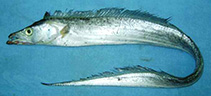
Espinas dorsales (total) : 3; Radios blandos dorsales (total) : 130 - 135; Radios blandos anales: 100 - 105. Body extremely elongate, compressed and tapering to a point. Mouth large with a dermal process at the tip of each jaw. Dorsal fin relatively high; anal fin reduced to minute spinules usually embedded in the skin or slightly breaking through; anterior margin of pectoral fin spine not serrated. Pelvic and caudal fins absent. Lateral line beginning at the upper margin of the gill cover, running oblique to behind the tip of the pectoral fins, then straight close to the ventral contour. Fresh specimens steely blue with silvery reflections, becoming uniformly silvery gray sometime after death (Ref. 6181).
Body shape (shape guide): eel-like; Cross section: compressed.
Generally over muddy bottoms of shallow coastal waters (Ref. 9351). Often enter estuaries (Ref. 9351). Juveniles feed mostly on euphausiids, small pelagic planktonic crustaceans and small fishes; adults feed mainly on fishes and occasionally on squids and crustaceans (Ref. 6181). Adults and juveniles have opposing complementary vertical diurnal feeding migration. Large adults usually feed near the surface during the daytime and migrate to the bottom at night. Juveniles and small adults form schools 100 m above the bottom during the daytime and form loose feeding aggregations at night near the surface. Pelagic eggs (Ref. 35388) and larvae (Ref. 6768). Max weight of 1.5 kg given in Ref. 28023 seems too low. The current angling world record was caught in Rio de Janeiro's Guanabara Bay and weighed 3.69 kg. Commercial fisherman have caught fish of up to 5 kg (Capt. Eduardo Baumeier, pers. Comm., 2001). Marketed salted or dried and also frozen (Ref. 9351). Excellent taste when fried or grilled; also for sashimi when fresh.
Nakamura, I. and N.V. Parin, 1993. FAO Species Catalogue. Vol. 15. Snake mackerels and cutlassfishes of the world (families Gempylidae and Trichiuridae). An annotated and illustrated catalogue of the snake mackerels, snoeks, escolars, gemfishes, sackfishes, domine, oilfish, cutlassfishes,. scabbardfishes, hairtails, and frostfishes known to date. FAO Fish. Synop. 125(15):136 p. (Ref. 6181)
Situación en la Lista Roja de la UICN (Ref. 130435: Version 2025-2 (Global))
Amenaza para el ser humano
Harmless
Usos humanos
Pesquerías: muy comercial; pesca deportiva: si
Herramientas
Informes especiales
Descargar XML
Fuentes de Internet
Estimaciones basadas en modelos
Temperatura preferida (Referencia
123201): 10.1 - 23.2, mean 15.2 °C (based on 1178 cells).
Índice de diversidad filogenética (Referencia
82804): PD
50 = 0.5010 [Uniqueness, from 0.5 = low to 2.0 = high].
Bayesian length-weight: a=0.00032 (0.00027 - 0.00039), b=3.17 (3.12 - 3.22), in cm total length, based on LWR estimates for this species (Ref.
93245).
Nivel trófico (Referencia
69278): 4.4 ±0.4 se; based on diet studies.
Generation time: 2.9 (1.3 - 4.2) years. Estimated as median ln(3)/K based on 15
growth studies.
Resiliencia (Referencia
120179): Medio, población duplicada en un tiempo mínimo de 1.4-4.4 años (K=0.25-0.29; tm=2-3.7; tmax=15; Fec=21,672).
Prior r = 0.21, 95% CL = 0.14 - 0.32, Based on 3 full stock assessments.
Vulnerabilidad pesquera (Ref.
59153): Moderate to high vulnerability (52 of 100).
🛈
Vulnerabilidad climática (Ref.
125649): High vulnerability (62 of 100).
🛈
Nutrientes (Ref.
124155): Calcium = 100 [30, 212] mg/100g; Iron = 1.23 [0.36, 2.72] mg/100g; Protein = 19.4 [17.7, 21.0] %; Omega3 = 0.256 [0.133, 0.574] g/100g; Selenium = 173 [63, 488] μg/100g; VitaminA = 3.29 [0.71, 21.47] μg/100g; Zinc = 0.855 [0.444, 1.405] mg/100g (wet weight); based on
nutrient studies.