>
Anguilliformes (Eels and morays) >
Ophichthidae (Snake eels) > Ophichthinae
Etymology: Brachysomophis: Greek, brachys, eia = short + Greek, soma = body + Greek, ophis = serpent (Ref. 45335); cirrocheilos: From apparently a combination of Latin ('cirrus' = tendril) and Greek ('cheilos' = lip).
More on author: Bleeker.
Môi trường: môi trường / vùng khí hậu / Mức độ sâu / phạm vi phân phối
Sinh thái học
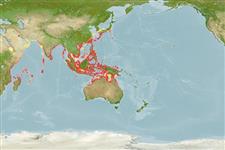
biển; thuộc về nước lợ cùng sống ở rạn san hô; mức độ sâu 1 - 38 m (Ref. 42180). Tropical; 39°N - 20°S, 35°E - 148°E (Ref. 42180)
Indo-West Pacific: Red Sea and East Africa to Japan, Taiwan south to Indonesia and Australia.
Bộ gần gũi / Khối lượng (Trọng lượng) / Tuổi
Chín muồi sinh dục: Lm ? range ? - ? cm
Max length : 159 cm TL con đực/không giới tính; (Ref. 42180)
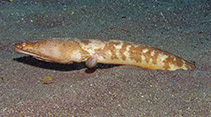
Động vật có xương sống: 135 - 140. Coloration pale, overlain dorsally and along flanks with irregular brown smudges. A moderately elongate species with tail 51-58% and head 11-14% of TL; dorsal fin arising well behind pectoral-fin tips; pectoral fins not elongate; snout moderate, about 3.2 in jaw; jaws elongate; lower jaw extending beyond snout; nostrils in very short tubes in upper lip and closely associated; labial fringe well-developed but cirri not elongate on jaws, with cauliflower-like projections at tips; center of eye behind anterior 40% of jaw; interorbital space and top of head flat, dorsal head profile nearly flat from mid-head to snout tip; head pores inconspicuous; free sensory neuromasts not visible on nape; teeth conical. Numerous prominent barbels on both lips; outer row of maxillary teeth not visible when are closed (Ref 42180).
Body shape (shape guide): eel-like; Cross section: circular.
Most commonly found in sand and mud, near coastal reefs at depths of 1 up to at least 10 m. Burrows into the sand tail-first until only its eyes and the top of its snout are visible. Sometimes seen with only its head or snout protruding from the sand. More commonly encountered at night but also seen with its head protruding out of the substrate during the day. Observed with cleaner shrimp Periclimenes magnificus on its head. The shrimp would swim off for short periods and then return to this species (Ref. 42180). Feeds on small fishes and crustaceans (Ref. 2334).
Vòng đời và hành vi giao phối
Chín muồi sinh dục | Sự tái sinh sản | Đẻ trứng | Các trứng | Sự sinh sản | Ấu trùng
McCosker, J.E. and J.E. Randall, 2001. Revision of the snake-eel genus Brachysomophis (Anguilliformes: Ophichthidae), with description of two new species and comments on the species of Mystriophis. Indo-Pac. Fish. (33):1-32. (Ref. 42180)
Tình trạng Sách đỏ IUCN (Ref. 130435: Version 2025-2 (Global))
Mối đe dọa đối với con người
Harmless
Sử dụng của con người
Các nghề cá: các nghề cá là sinh kế
Các công cụ
Báo cáo đặc biệt
Tải xuống XML
Các nguồn internet
Ước tính dựa trên mô hình
Nhiệt độ ưa thích (Tài liệu tham khảo
123201): 25 - 29, mean 27.9 °C (based on 520 cells).
Chỉ số đa dạng phát sinh loài (Tài liệu tham khảo
82804): PD
50 = 0.5078 [Uniqueness, from 0.5 = low to 2.0 = high].
Bayesian length-weight: a=0.00093 (0.00041 - 0.00214), b=2.99 (2.79 - 3.19), in cm total length, based on LWR estimates for this (Sub)family-body shape (Ref.
93245).
Mức dinh dưỡng (Tài liệu tham khảo
69278): 4.0 ±0.66 se; based on food items.
Thích nghi nhanh (Tài liệu tham khảo
120179): thấp, thời gian nhân đôi của chủng quần tối thiểu là 4.5 - 14 năm (Preliminary K or Fecundity.).
Sự dễ bị tổn thương của nghề đánh cá (Ref.
59153): Very high vulnerability (90 of 100).
🛈