Environnement : milieu / zone climatique / profondeur / gamme de distribution
Écologie
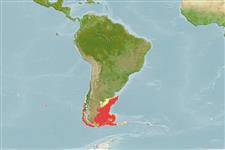
marin; saumâtre démersal; profondeur 0 - 600 m (Ref. 11954). Temperate; 37°S - 56°S
Southeast Pacific and Southwest Atlantic: Chile and Argentina, including Tierra del Fuego (Ref. 27363).
Taille / Poids / Âge
Maturité: Lm ? range ? - ? cm
Max length : 35.6 cm TL mâle / non sexé; (Ref. 27363)
Description synthétique
Clés d'identification | Morphologie | Morphométrie
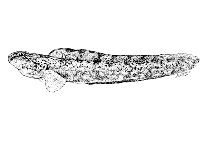
Épines dorsales (Total) : 0; Rayons mous dorsaux (Total) : 85; Épines anales: 0; Rayons mous anaux: 71; Vertèbres: 83 - 97. This genus is distinguished by the following characters: presence of submental crests, not fused anteriorly; elongated and narrow neurocranium; the frontal bones are totally fused with no trace of a suture, the frontal corner squared; long frontal ramus; the sphenotic and parietal separated by pterotic; parietal bones meet in the mid-line; parasphenoid wing height high; juncture of ceratohyal-epihyal is smooth; branchiostegal rays 5; posterior hyomandibular ramus elongate; well developed palatal arch and posttemporal ventral ramus; scapular foramen enclosed by bone; with scapular strut; 4 notched radials (= actinosts); with postcleithrum; 85 dorsal fin-rays (last 7 counted from dorsal-fin pterygiophores); 71 anal-fin rays (last 10 counted from anal-fin pterygiophores); 18 pectoral fin rays; presence of pelvic bone; vertebrae asymmetrical (21+68=89); ribs on 4?21 abdominal vertebrae; 1 epural; dorsal-fin origin associated with vertebrae 4; well developed oral valve; gill slit extending ventrally to lower end of pectoral-fin base; blunt gill rakers; nub-like pyloric caeca; presence of scales, palatine and vomerine teeth; pale oral cavity; black peritoneum; a blurred brown band between the anteroventral edge of the eye and the upper jaw.
Additional diagnostic characters are the following: frontal and parasphenoid not separated by pterosphenoid; supraoccipital-exoccipìtal articulation excluded by epioccipitals; no supratemporal commissure and occipital pores; ascending rami of the parasphenoid reaches the upper margin of the trigeminofacialis foramen; well developed intercalar, not reaching prootic; 8-9 suborbital bones, canal with 7 pores; postorbital pores 1 and 4; single posterior nasal pore; cartilaginous basal plate of pectoral girdle with three foramina; vertebrae asymmetrical (19-21+ 64-77 = 83-97); dorsal-fin origin associated with vertebrae 2-4; well developed oral valve; blunt gill rakers; pelvic-fin rays ensheathed; squamation extensive, but head and pectoral-fin base and axil have no scales; lateral line mediolateral, palatine teeth 9-23; vomerine teeth 7-17 (Ref. 90127).
Body shape (shape guide): elongated; Cross section: oval.
Found from the intertidal zone and brackish areas out to about 600 m (Ref. 11954).
Cycle de vie et comportement reproducteur
Maturité | Reproduction | Frai | Œufs | Fécondité | Larves
Matallanas, J. and C. Corbella, 2012. Redescription of Iluocoetes Jenyns, 1842; proposal of a new genus, Argentinolycus, for Iluocoetes elongatus (Smitt, 1898), and description of Patagolycus melastomus gen. et sp. nov. (Teleostei, Zoarcidae). Zootaxa 3296:1-18. (Ref. 90127)
Statut dans la liste rouge de l'IUCN (Ref. 130435: Version 2025-2 (Global))
Menace pour l'homme
Harmless
Utilisations par l'homme
Pêcheries: sans intérêt
Outils
Articles particuliers
Télécharger en XML
Sources Internet
Estimations basées sur des modèles
Température préférée (Réf.
123201): 4.5 - 9.7, mean 6.6 °C (based on 341 cells).
Indice de diversité phylogénétique (Réf.
82804): PD
50 = 1.0000 [Uniqueness, from 0.5 = low to 2.0 = high].
Bayesian length-weight: a=0.00282 (0.00145 - 0.00550), b=3.20 (3.03 - 3.37), in cm total length, based on LWR estimates for this (Sub)family-body shape (Ref.
93245).
Niveau trophique (Réf.
69278): 3.4 ±0.4 se; based on size and trophs of closest relatives
Résilience (Réf.
120179): Faible, temps minimum de doublement de population : 4,5 à 14 années (Preliminary K or Fecundity.).
Vulnérabilité de la pêche (Ref.
59153): Low to moderate vulnerability (26 of 100).
🛈
Nutriments (Ref.
124155): Calcium = 39.7 [23.0, 72.1] mg/100g; Iron = 0.312 [0.185, 0.538] mg/100g; Protein = 16.4 [12.7, 19.8] %; Omega3 = 0.511 [0.291, 0.861] g/100g; Selenium = 17.7 [8.5, 41.5] μg/100g; VitaminA = 16.6 [5.7, 48.1] μg/100g; Zinc = 0.693 [0.499, 0.982] mg/100g (wet weight); based on
nutrient studies.