Milieu: milieu / Klimaatzone / Diepte / verspreidingsgebied
Ecologie
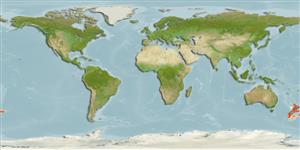
marien demersaal; diepte 30 - 600 m (Ref. 58489). Temperate; 34°S - 52°S, 158°E - 174°W
Southwest Pacific: endemic to New Zealand.
Lengte bij maturiteit / Grootte / Gewicht / Leeftijd
Maturiteit: Lm 47.5, range 45 - 50 cm
Max length : 90.0 cm TL mannelijk / geslacht onbekend; (Ref. 9988); common length : 46.0 cm TL mannelijk / geslacht onbekend; (Ref. 9049); max. gerapporteerde leeftijd: 20 Jaren (Ref. 9072)
Korte beschrijving
Determinatiesleutels | Morfologie | Morfometrie
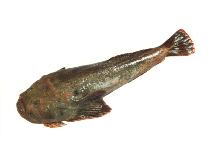
Dorsale zachte stralen (totaal) : 17 - 19; Anale zachte stralen: 17 - 18; Wervels: 33 - 34. This species is distinguished by the following characters: D 17-19; A 17-18; vertebrae 33-34; body rather elongate, tapering from a moderately broad, flat, bony head (width 1.1-1.4 times its length) covered with tiny blunt spines in juveniles to low radiating ridges in adults; small eyes directed upwards; bony orbital rim separated medially by naked rectangular space; mouth large, vertical, with several prominent canines between smaller canines; chin smooth; lips with short ridge-like crenulations; ventral margin of preopercle with four spine-like processes; anterior end of isthmus with a pair of prominent forward directed spines; prominent cleithral spine sheathed with skin above pectoral fin base; gill rakers on first arch 14-17, in the form of patches of fine teeth, patches narrow, teeth in three or four rows, innermost row rather long; no scales; lateral line pores in skin high on side close to base of dorsal fin; dorsal fin low, elongate, its base 67-82% of predorsal length; pectoral fins huge, fan-like; pelvic fins moderately large, length 20-25% SL (Ref. 86516).
Body shape (shape guide): fusiform / normal.
Reported from depths between 30 m (Ref. 58489) and 600 m (Ref. 9258). Buries in sea bed until suitable prey passes by. Utilized fresh and frozen; can be steamed, broiled and baked (Ref. 9988).
Levenscyclus en paargedrag
Maturiteit | Voortplanting | Paaien | Eieren | Fecunditeit | Larven
Armitage, R.O., D.A. Payne, G.J. Lockley, H.M. Currie, R.L. Colban, B.G. Lamb and L.J. Paul (eds.), 1994. Guide book to New Zealand commercial fish species. Revised edition. New Zealand Fishing Industry Board, Wellington, New Zealand, 216 p. (Ref. 9258)
Status op de Rode Lijst van het IUCN (Ref. 130435: Version 2025-2 (Global))
Gevaar voor de mens
Harmless
Gebruik door de mens
Visserij: commercieel
Tools
Speciale rapporten
Download XML
Internetbronnen
Schattingen op basis van modellen
Gewenste temperatuur (Ref.
123201): 7.8 - 14.3, mean 11.2 °C (based on 62 cells).
Fylogenetische diversiteitsindex (Ref.
82804): PD
50 = 0.5020 [Uniqueness, from 0.5 = low to 2.0 = high].
Bayesian length-weight: a=0.01230 (0.00648 - 0.02335), b=3.02 (2.85 - 3.19), in cm total length, based on LWR estimates for this species & (Sub)family-body (Ref.
93245).
Trofisch niveau (Ref.
69278): 4.2 ±0.58 se; based on food items.
Weerstandsvermogen (Ref.
120179): laag, minimale populatieverdubbelingstijd 4,5-14 jaar (tm=3; tmax=20; K=0.1-0.2;).
Prior r = 0.34, 95% CL = 0.22 - 0.51, Based on 1 full stock assessment.
Kwetsbaarheid van de visserij (Ref.
59153): Moderate to high vulnerability (51 of 100).
🛈
Kwetsbaarheid voor het klimaat (Ref.
125649): High to very high vulnerability (71 of 100).
🛈
Voedingsstoffen (Ref.
124155): Calcium = 20.6 [14.1, 37.8] mg/100g; Iron = 0.324 [0.212, 0.523] mg/100g; Protein = 18.7 [17.9, 19.5] %; Omega3 = 0.679 [0.432, 1.032] g/100g; Selenium = 20.5 [11.4, 37.8] μg/100g; VitaminA = 16.4 [5.6, 49.6] μg/100g; Zinc = 0.368 [0.278, 0.500] mg/100g (wet weight);