>
Mugiliformes (Mullets) >
Mugilidae (Mullets)
Eponymy: Fred C Aldrich was Chief Inspector of Fisheries and Game, Perth, Western Australia. We have failed to locate further information about him. Johann Reinhold Forster (1729–1798) was a German clergyman in Danzig (now Gdansk, Poland). [...] (Ref. 128868), visit book page.
More on author: Valenciennes.
Entorno: milieu / zona climática / rango de profundidad / gama de distribución
Ecología
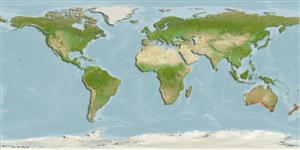
marino; agua dulce; salobre demersal; catadromo (Ref. 46888); rango de profundidad 0 - 50 m (Ref. 9003), usually 0 - 10 m (Ref. 9812). Temperate; ? - 28°C (Ref. 28706); 25°S - 47°S, 112°E - 173°W
Southwest Pacific: throughout New Zealand and the Chatham Islands; also from eastern, western Australia, southern Australia and Tasmania.
Tamaño / Peso / Edad
Madurez: Lm ? range ? - ? cm
Max length : 50.0 cm SL macho / no sexado; (Ref. 44894); common length : 25.0 cm TL macho / no sexado; (Ref. 9258); peso máximo publicado: 950.00 g (Ref. 26498); edad máxima reportada: 7 años (Ref. 9003)
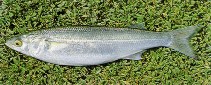
Espinas dorsales (total) : 5; Radios blandos dorsales (total) : 9; Espinas anales: 3; Radios blandos anales: 12. More pointed head and mouth than Mugil cephalus, and their eyes lack adipose (fatty) eyelids. Body scales are small (54-64 between gill opening and tail base) and thin, and are easily dislodged. 2 widely separated dorsal fins, the first with 4 spines and the second with 1 spine and 9 rays. These fish are olive or bluish brown above and silvery on the sides, and their eyes are bright yellow or golden. The fins have brown margins.
Body shape (shape guide): fusiform / normal; Cross section: compressed.
Found over sandy and muddy bottoms of coastal waters, bays, estuaries, and may ascend rivers into freshwaters (Ref. 9812, 44894). Adults inhabit brackish coastal lakes (Ref. 44894). Found in schools (Ref. 9812). Shoal-forming (Ref. 44894). They are omnivores, feeding mostly on benthic detritus, algae and small invertebrates. Oviparous, eggs are pelagic and non-adhesive (Ref. 205). Spawn in coastal waters in summer and autumn, probably in estuaries (Ref. 9812, 27012, 28470, 28707, 28708). Marketed fresh (whole gutted or fillets), smoked, salted or as roe (Ref. 3383).
Yellow eye mullet form large aggregations prior to spawning (Ref. 6390).
Kailola, P.J., M.J. Williams, P.C. Stewart, R.E. Reichelt, A. McNee and C. Grieve, 1993. Australian fisheries resources. Bureau of Resource Sciences, Canberra, Australia. 422 p. (Ref. 6390)
Situación en la Lista Roja de la UICN (Ref. 130435: Version 2025-2 (Global))
Amenaza para el ser humano
Usos humanos
Pesquerías: comercial; pesca deportiva: si
Herramientas
Informes especiales
Descargar XML
Fuentes de Internet
Estimaciones basadas en modelos
Temperatura preferida (Referencia
123201): 13.5 - 20.2, mean 17.1 °C (based on 354 cells).
Índice de diversidad filogenética (Referencia
82804): PD
50 = 1.0000 [Uniqueness, from 0.5 = low to 2.0 = high].
Bayesian length-weight: a=0.01175 (0.00553 - 0.02496), b=2.96 (2.79 - 3.13), in cm total length, based on LWR estimates for this (Sub)family-body shape (Ref.
93245).
Nivel trófico (Referencia
69278): 2.5 ±0.26 se; based on food items.
Generation time: 2.2 ( na - na) years. Estimated as median ln(3)/K based on 1
growth studies.
Resiliencia (Referencia
120179): Medio, población duplicada en un tiempo mínimo de 1.4-4.4 años (tm=2-3; tmax=7; Fec=125,000).
Vulnerabilidad pesquera (Ref.
59153): Low to moderate vulnerability (29 of 100).
🛈
Nutrientes (Ref.
124155): Calcium = 45.6 [15.7, 139.4] mg/100g; Iron = 0.36 [0.14, 1.08] mg/100g; Protein = 18.4 [16.4, 20.5] %; Omega3 = 0.804 [0.340, 1.805] g/100g; Selenium = 34.3 [12.1, 99.0] μg/100g; VitaminA = 8.44 [1.77, 41.50] μg/100g; Zinc = 0.918 [0.449, 1.692] mg/100g (wet weight); based on
nutrient studies.