Ambiente: milieu / zona climatica / distribuzione batimetrica / gamma di distribuzione
Ecologia
marino benthopelagico; distribuzione batimetrica 0 - 20 m (Ref. 13227). Temperate
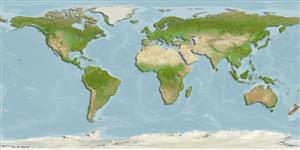
Southwest Pacific: throughout New Zealand. Records from Chatham Islands are unconfirmed (Ref. 9003).
Dimensione / Peso / Età
Maturità: Lm ? range ? - ? cm
Max length : 6.7 cm SL maschio/sesso non determinato; (Ref. 13227); Età massima riportata: 3.00 anni (Ref. 13227)
Breve descrizione
Chiavi di identificazione | Morfologia | Morfometria
Spine dorsali (totale) : 24 - 31; Raggi dorsali molli (totale) : 11 - 14; Spine anali: 2; Raggi anali molli: 23 - 27; Vertebre: 40 - 45. First dorsal fin spines V-VIII; second dorsal fin spines XIX-XXIII; third dorsal fin rays 11-14.
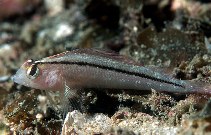
Discontinuous lateral line tubular scales 19-24, notched scales 14-24. Total vertebral number 43-45. Snout profile steep (70-75°). Preoperculo-mandibular canal with 7 pores, 3 at lower corner of preopercular, 3 at tip of upper jaw and 1 at lower jaw symphysis. Scale rows between anterior end of second dorsal fin and lateral line, 5-6. Scales between second and third dorsal fins, 4. Scales around caudal peduncle 12-13. Radii in scales from area below lateral line and under pectoral fin, 8-11. Long ctenii in scales from above and below lateral line in caudal peduncle area. Lateral line canal constricted with W-shaped anterior and posterior openings. Short denticles on interradial circuli. Post-temporal partially exposed. Pterygiophore supporting first segmented ray of third dorsal fin anterior to 24th vertebra. Dorsal fin formula V-0N-0-1-0-1. Ventral edge of lower caudal plate straight. Short neural spine of second preural vertebra. Epurals of different length. Soft rays in caudal fin, 14; 2 unbranched and 5 branched (non multibranched) rays in upper and lower caudal lobes. Procurrent rays in upper caudal lobe, 10; eight in lower lobe, 8; in upper lobe, 2 procurrent rays between upper lobe and posterior epural, 4 rays opposite epurals , 1 between neural spine of second preural vertebra and neural spine of third vertebra, 1 opposite neural spine of third preural vertebra and 2 anterior to neural spine of third vertebra; in lower lobe, one procurrent ray between lower lobe
and haemal spine of second preural vertebra, 5 rays opposite haemal spine of second preural vertebra, 1 between haemal spines of second and third preural vertebrae, 1 ray opposite neural spine of third preural vertebra. Rounded posterior end. Short, pointed rostrum. Broad antristrum. Excisura shallow (Ref. 84085).
Body shape (shape guide): elongated.
Facultative air-breathing in the genus (Ref. 126274); Adults are most common in shallow water (0-5m), although recorded from depths of 30 m (Ref. 84085). They are commonly found in intertidal rock pools, particularly those with adequate rocky or algal shelter. They feed mainly on amphipods, isopods, and polychaetes (Ref. 13227). Eggs are hemispherical and covered with numerous sticky threads that anchor them in the algae on the nesting sites (Ref. 240). Larvae are planktonic which occur primarily in shallow, nearshore waters (Ref. 94114).
Ciclo vitale e comportamento di accoppiamento
Maturità | Riproduzione | Deposizione | Uova | Fecondità | Larve
Fricke, R., 1994. Tripterygiid fishes of Australia, New Zealand and the southwest Pacific Ocean (Teleostei). Theses Zool. 24:1-585. (Ref. 13227)
Stato della Lista Rossa IUCN (Ref. 130435: Version 2025-2 (Global))
Minaccia per l'uomo
Harmless
Usi umani
Pesca: di nessun interesse
Strumenti
Rapporti speciali
Scarica XML
Fonti Internet
Stime basate su modelli
Temperatura preferita (Fonte Biblio.
123201): 10.4 - 18.5, mean 14.9 °C (based on 161 cells).
Indice di diversità filogenetica (Fonte Biblio.
82804): PD
50 = 0.5039 [Uniqueness, from 0.5 = low to 2.0 = high].
Bayesian length-weight: a=0.00631 (0.00356 - 0.01119), b=3.07 (2.91 - 3.23), in cm total length, based on LWR estimates for this species & (Sub)family-body (Ref.
93245).
Livello trofico (Fonte Biblio.
69278): 3.2 ±0.45 se; based on food items.
Generation time: 0.9 ( na - na) years. Estimated as median ln(3)/K based on 1
growth studies.
Resilienza (Fonte Biblio.
120179): Alto, tempo minimo di raddoppiamento della popolazione meno di 15 mesi (K=1.20; tmax=3).
Vulnerabilità della pesca (Ref.
59153): Low vulnerability (11 of 100).
🛈
Nutrienti (Ref.
124155): Calcium = 130 [65, 298] mg/100g; Iron = 0.491 [0.264, 0.997] mg/100g; Protein = 17.2 [16.0, 18.3] %; Omega3 = 0.422 [0.172, 0.977] g/100g; Selenium = 9.31 [3.45, 25.01] μg/100g; VitaminA = 35.9 [7.7, 169.3] μg/100g; Zinc = 1.32 [0.84, 2.00] mg/100g (wet weight);