>
Eupercaria/misc (Various families in series Eupercaria) >
Labridae (Wrasses) > Julidinae
Etymology: Macropharyngodon: Greek, makros = great + Greek, pharyngx = pharynx + Greek,odous = teeth (Ref. 45335).
More on author: Randall.
Milieu: milieu / Klimaatzone / Diepte / verspreidingsgebied
Ecologie
marien rifbewoner; standvastig; diepte 4 - 16 m. Tropical
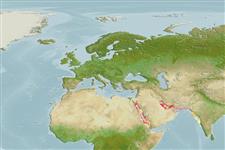
Western Indian Ocean: Red Sea.
Grootte / Gewicht / Leeftijd
Maturiteit: Lm ? range ? - ? cm
Max length : 9.5 cm SL mannelijk / geslacht onbekend; (Ref. 2694)
Korte beschrijving
Determinatiesleutels | Morfologie | Morfometrie
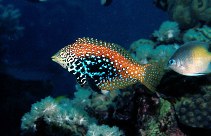
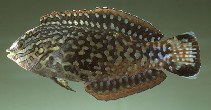
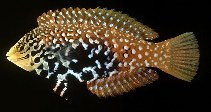
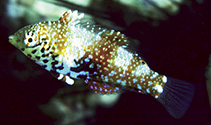
Dorsale stekels (totaal) : 9; Dorsale zachte stralen (totaal) : 11; Anale stekels: 3; Anale zachte stralen: 11. This species is distinguished by the following characters: D IX,11; A III,11; pectoral rays 12 (including upper rudimentary ray); complete lateral line, angling downward below last 3 or 4 dorsal rays to straight peduncular portion, 27 pored scales (plus 1 on base of caudal fin); anterior lateral-line scales with 2 or 3 (rarely 4) pores; gill rakers 14-17; body depth 2.6-2.9 in SL; head length (HL) 2.95-3.05 in SL; snout short, 3.3-3.7 in HL; upper jaw with 2 pairs of canine teeth, 1st pair straight and strongly projecting anteriorly, 2nd pair about two-thirds as long, with tips recurved and outflaring; lower jaw with a medial pair of long, straight, forward-jutting, canine teeth, each with an adjacent more slender canine about two-thirds as long, with recurved tip; side of jaws with single row of close-set conical teeth, progressively shorter posteriorly; a very large, slender, forward-projecting, canine tooth posteriorly on upper jaw; lower pharyngeal plate with an enormous central molariform tooth, on each side anteriorly with a row of small conical teeth, continuing as a single row on the long anterior process; each of the pair of upper pharyngeal plates with 2 large, nearly square molars, preceded by a patch of small stout conical teeth; orbit diameter 4.25-4.95 in HL; origin of dorsal fin slightly anterior to a vertical at upper end of gill opening; first dorsal spine 4.25-5.25 in HL; remaining spines progressively longer, 9th 3.1-3.25 in HL; 5th or 6th dorsal soft ray longest, 1.9-2.2 in HL; 3rd anal spine longest, 2.45-3.55 in HL; 5th or 6th anal soft ray longest, 1.95-2.2 in HL; caudal fin slightly rounded, 1.2-1.3 in HL; pectoral fins 1.4-1.5 in HL; pelvic fins 1.35-1.8 in HL, usually reaching to or slightly posterior to origin of anal fin in mature males, usually not reaching anus in females (Ref. 93522).
Body shape (shape guide): short and / or deep; Cross section: compressed.
Levenscyclus en paargedrag
Maturiteit | Voortplanting | Paaien | Eieren | Fecunditeit | Larven
Oviparous, distinct pairing during breeding (Ref. 205).
Randall, J.E., 2013. Seven new species of labrid fishes (Coris, Iniistius, Macropharyngodon, Novaculops, and Pteragogus) from the Western Indian Ocean. J. Ocean Sci. Found. 7:1-43. (Ref. 93522)
Status op de Rode Lijst van het IUCN (Ref. 130435: Version 2025-2 (Global))
Gevaar voor de mens
Harmless
Gebruik door de mens
Tools
Speciale rapporten
Download XML
Internetbronnen
Schattingen op basis van modellen
Gewenste temperatuur (Ref.
123201): 24.6 - 29.3, mean 27.5 °C (based on 183 cells).
Fylogenetische diversiteitsindex (Ref.
82804): PD
50 = 0.5002 [Uniqueness, from 0.5 = low to 2.0 = high].
Bayesian length-weight: a=0.01995 (0.00906 - 0.04395), b=3.01 (2.83 - 3.19), in cm total length, based on all LWR estimates for this body shape (Ref.
93245).
Trofisch niveau (Ref.
69278): 3.5 ±0.4 se; based on size and trophs of closest relatives
Weerstandsvermogen (Ref.
120179): Hoog, minimale populatieverdubbelingstijd minder dan 15 maanden (Preliminary K or Fecundity.).
Kwetsbaarheid van de visserij (Ref.
59153): Low vulnerability (10 of 100).
🛈
Voedingsstoffen (Ref.
124155): Calcium = 115 [56, 202] mg/100g; Iron = 0.782 [0.386, 1.575] mg/100g; Protein = 18.1 [15.2, 20.4] %; Omega3 = 0.125 [0.071, 0.214] g/100g; Selenium = 19.9 [10.4, 40.6] μg/100g; VitaminA = 125 [33, 637] μg/100g; Zinc = 1.66 [1.05, 2.79] mg/100g (wet weight);