>
Beloniformes (Needle fishes) >
Belonidae (Needlefishes)
Etymology: Strongylura: Greek, strongylos = round + Greek, oura = tail (Ref. 45335).
Umwelt: Milieu / Klimazone / Tiefenbereich / Verbreitungsgebiet
Ökologie
seewasser; brackwasser pelagic-neritic; tiefenbereich 5 - 25 m (Ref. 122660). Tropical; 30°N - 27°S
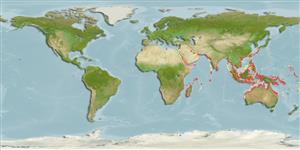
Indo-West Pacific: Persian Gulf eastward along the coasts of Pakistan, India, and Sri Lanka, then extending to southern China, the Philippines, and northern Australia. A record from Zanzibar (Tanzania) needs confirmation.
Größe / Gewicht / Alter
Geschlechtsreife: Lm ? range ? - ? cm
Max length : 40.0 cm SL Männchen/unbestimmt; (Ref. 4833); common length : 22.0 cm SL Männchen/unbestimmt; (Ref. 9682)
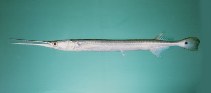
Rückenflossenstacheln (insgesamt) : 0; Rückenflossenweichstrahlen (insgesamt) : 12 - 15; Afterflossenstacheln: 0; Afterflossenweichstrahlen: 15 - 18; Wirbelzahl: 59 - 65. Round in cross section. Dorsal fin rays 12-15; anal fin rays 15-18. Caudal peduncle without lateral keels. Caudal fin rounded or truncate. Predorsal scales few and relatively large, 100-130. Caudal fin light with a prominent round black spot near its base. Dorsal fin lobe and distal margin of caudal fin yellow in live adults, anterior margin of anal fin orange.
Body shape (shape guide): elongated; Cross section: circular.
Found in coastal areas and mangrove-lined lagoons, also enters freshwater. Carnivorous. Feeds mainly on small fishes, especially clupeoids. Occurs at temperatures ranging from 26 to 29°C (Ref. 4959). Oviparous (Ref. 205). Eggs may be found attached to objects in the water by tendrils on the egg's surface (Ref. 205). Sold fresh in markets.
Lebenszyklus und Paarungsverhalten
Geschlechtsreife | Fortpflanzung | Ablaichen | Eier | Fruchtbarkeit | Larven
Collette, B.B., 1984. Belonidae. In W. Fischer and G. Bianchi (eds.) FAO species identification sheets for fishery purposes. Western Indian Ocean (Fishing Area 51), Volume 1. FAO, Rome. (Ref. 3130)
IUCN Rote Liste Status (Ref. 130435: Version 2025-2 (Global))
Bedrohung für Menschen
Harmless
Nutzung durch Menschen
Fischereien: kommerziell
Tools
Zusatzinformationen
Download XML
Internet Quellen
Schätzungen auf der Grundlage von Modellen
Bevorzugte Temperatur (Ref.
123201): 25.1 - 29.2, mean 28.5 °C (based on 2807 cells).
Phylogenetischer Diversitätsindex (Ref.
82804): PD
50 = 0.5000 [Uniqueness, from 0.5 = low to 2.0 = high].
Bayesian length-weight: a=0.00102 (0.00055 - 0.00189), b=3.09 (2.93 - 3.25), in cm total length, based on LWR estimates for this species & Genus-body shape (Ref.
93245).
Trophische Ebene (Ref.
69278): 4.2 ±0.73 se; based on food items.
Widerstandsfähigkeit (Ref.
120179): hoch, Verdopplung der Population dauert weniger als 15 Monate. (Preliminary K or Fecundity.).
Anfälligkeit der Fischerei (Ref.
59153): Moderate vulnerability (39 of 100).
🛈