>
Beryciformes (Sawbellies) >
Berycidae (Alfonsinos)
Etymology: Beryx: Greek, beryx or berys = a name of a fish. Cuvier & Valenciennes (1829:221) precise that the name was used by Gesner from Varinus, but with no indication whatsoever helping identifying any species. After D'Arcy Wentworth Thompson (A glossary of Greek fishes, 1947), the name actually seems to come originally from Hesychius, but perhaps the name was not originally a fish name. Thompson compares it to meryx (ruminant), applied on skaros (Scarus), so it may have been applied on a parrot fish referring to its browsing/grazing behavior described by Aristoteles and followers.
More on author: Lowe.
Meio ambiente: milieu / Zona climática / intervalo de profundidade / faixa de distribuição
Ecologia
marinhas bentopelágico; oceanódromo (Ref. 87829); intervalo de profundidade 25 - 1300 m (Ref. 9833), usually 400 - 600 m (Ref. 27121). Subtropical; 45°N - 43°S, 180°W - 180°E
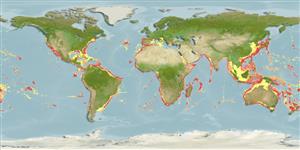
Circumglobal, excluding the northeast Pacific and Mediterranean Sea (Ref. 9833). Western Atlantic: Gulf of Maine to the Gulf of Mexico (Ref. 6743). Eastern Atlantic: off southwestern Europe and the Canary Islands (Ref. 7413) to South Africa (Ref. 4179). Indo-Pacific: East Africa (including Saya de Malha Bank, Ref. 33390) to Japan, Hawaii, Australia, and New Zealand (Ref. 5755). The limited number of records in the western Pacific is doubtless the result of limited fishing effort below 200 m (Ref. 9833). Eastern Pacific: Chile (Ref. 27363).
Comprimento de primeira maturação / Tamanho / Peso / Idade
Maturidade: Lm 33.2 range ? - ? cm
Max length : 70.0 cm TL macho/indeterminado; (Ref. 30573); common length : 40.0 cm TL macho/indeterminado; (Ref. 30573); peso máx. publicado: 4.0 kg (Ref. 43448); idade máx. registrada: 23 anos (Ref. 35874)
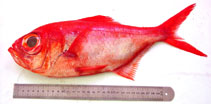
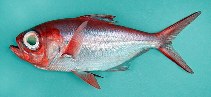
Espinhos dorsais (total) : 4; Raios dorsais (total) : 13 - 16; Espinhos anais: 4; Raios anais : 26 - 30. First infraorbital bone with a spine projecting laterally on anterior end. Lateral line extends to caudal fin. A fleshy disk on inner face of exposed area of scale. In young fishes, the 2nd dorsal ray is elongate (Ref. 559). Ref. 27363 notes pectoral fins with one spine and 17 soft rays (Ref. 27363).
Body shape (shape guide): fusiform / normal; Cross section: compressed.
Adults inhabit the outer shelf (180 m) and slope to at least 1,300 m depth, probably moving further from the bottom at night; often found over seamounts (Ref. 9833) and underwater ridges (Ref. 33648). Are considered as one of the straddling stocks in the northwest Pacific (Ref. 87829). They feed mainly on fish, crustaceans and cephalopods (Ref. 33648). Oviparous, spawn in batches (Ref. 30291). Juveniles (Ref. 9072), eggs and larvae are pelagic (Ref. 30291). Marketed frozen and eaten steamed, fried, broiled, boiled, microwaved and baked (Ref. 9988).
Spawning occurs about 10 to 12 times at intervals of about 4 days during the breeding season (Ref. 58433).
Maul, G.E., 1990. Berycidae. p. 626. In J.C. Quero, J.C. Hureau, C. Karrer, A. Post and L. Saldanha (eds.) Check-list of the fishes of the eastern tropical Atlantic (CLOFETA). JNICT, Lisbon; SEI, Paris; and UNESCO, Paris. Vol. 2. (Ref. 7413)
Status na Lista Vermelha da UICN (Ref. 130435: Version 2025-2 (Global))
Ameaça para os humanos
Harmless
Uso pelos humanos
Pescarias: espécies comerciais; peixe esportivo: sim
Ferramentas
Relatórios especiais
Baixar XML
Fontes da internet
Estimativas baseadas em modelos
Temperatura preferida (Ref.
123201): 6.6 - 12.9, mean 9.2 °C (based on 569 cells).
Índice de diversidade filogenética (Ref.
82804): PD
50 = 0.6260 [Uniqueness, from 0.5 = low to 2.0 = high].
Bayesian length-weight: a=0.01514 (0.01150 - 0.01991), b=3.05 (2.97 - 3.13), in cm total length, based on LWR estimates for this species (Ref.
93245).
Nível Trófico (Ref.
69278): 4.3 ±0.2 se; based on diet studies.
Generation time: 7.5 (6.2 - 8.3) years. Estimated as median ln(3)/K based on 15
growth studies.
Resiliência (Ref.
120179): Baixo, tempo mínimo de duplicação da população 4,5 - 14 anos (K=0.10-0.18; tm=5-7.5; tmax=23; Fec = 270,000).
Prior r = 0.28, 95% CL = 0.19 - 0.42, Based on 1 data-limited stock assessment.
Vulnerabilidade da pesca (Ref.
59153): High vulnerability (59 of 100).
🛈
Vulnerabilidade climática (Ref.
125649): High vulnerability (58 of 100).
🛈
Nutrientes (Ref.
124155): Calcium = 30.7 [9.0, 106.2] mg/100g; Iron = 0.746 [0.364, 1.431] mg/100g; Protein = 17.8 [16.7, 19.0] %; Omega3 = 0.472 [0.193, 1.101] g/100g; Selenium = 52.9 [26.3, 104.7] μg/100g; VitaminA = 26.8 [9.1, 86.8] μg/100g; Zinc = 0.553 [0.382, 0.825] mg/100g (wet weight);