Elasmobranquios (tiburones y rayas) (sharks and rays) >
Myliobatiformes (Stingrays) >
Rhinopteridae (Cownose rays)
Etymology: Rhinoptera: Greek, rhinos = nose + Greek,pteron = fin, wing (Ref. 45335).
Eponymy: Franz Steindachner (1834–1919) was an Austrian zoologist who specialised in herpetology and ichthyology. [...] (Ref. 128868), visit book page.
More on authors: Evermann & Jenkins.
Entorno: milieu / zona climática / rango de profundidad / gama de distribución
Ecología
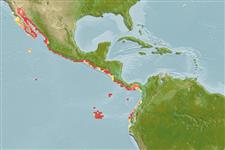
marino asociado a arrecife; oceanodromo (Ref. 51243); rango de profundidad 0 - 65 m (Ref. 117244), usually 0 - 25 m. Tropical; 32°N - 5°S, 117°W - 76°W
Eastern Pacific: Gulf of California to Costa Rica and the Galapagos Islands. Probably occurring elsewhere.
Longitud en la primera madurez / Tamaño / Peso / Edad
Madurez: Lm 71.0, range 65 - ? cm
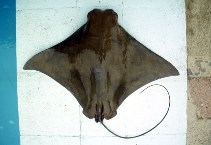
Max length : 91.6 cm WD macho / no sexado; (Ref. 116975)
Adults are found over soft bottoms, near rocky or coral reefs; also near reef drop-offs (Ref. 12951). They occasionally swim near the surface and may jump out of the water. Often in schools, sometimes associated with Aetobatus narinari, the spotted eagle ray (Ref. 12951). Adults feed on benthic crustaceans and mollusks. Ovoviviparous (Ref. 50449).
Exhibit ovoviparity (aplacental viviparity), with embryos feeding initially on yolk, then receiving additional nourishment from the mother by indirect absorption of uterine fluid enriched with mucus, fat or protein through specialised structures (Ref. 50449).
McEachran, J.D. and G. Notarbartolo di Sciara, 1995. Rhinopteridae. Gavilanes. p. 782-783. In W. Fischer, F. Krupp, W. Schneider, C. Sommer, K.E. Carpenter and V. Niem (eds.) Guia FAO para Identification de Especies para los Fines de la Pesca. Pacifico Centro-Oriental. 3 Vols. FAO, Rome. (Ref. 9263)
Situación en la Lista Roja de la UICN (Ref. 130435: Version 2025-2 (Global))
Amenaza para el ser humano
Harmless
Usos humanos
Pesquerías: sin interés; Acuario: Acuarios públicos
Herramientas
Informes especiales
Descargar XML
Fuentes de Internet
Estimaciones basadas en modelos
Temperatura preferida (Referencia
123201): 19.7 - 29.1, mean 24.2 °C (based on 266 cells).
Índice de diversidad filogenética (Referencia
82804): PD
50 = 0.5156 [Uniqueness, from 0.5 = low to 2.0 = high].
Bayesian length-weight: a=0.01148 (0.00468 - 0.02819), b=2.98 (2.76 - 3.20), in cm total length, based on LWR estimates for this (Sub)family-body shape (Ref.
93245).
Nivel trófico (Referencia
69278): 3.6 ±0.50 se; based on food items.
Generation time: 4.4 ( na - na) years. Estimated as median ln(3)/K based on 1
growth studies.
Resiliencia (Referencia
120179): Muy bajo, población duplicada en un tiempo mínimo superior a 14 años (k = 0.25; tmax = 10.75; tm = 3.92; Fec = 1).
Vulnerabilidad pesquera (Ref.
59153): Moderate to high vulnerability (50 of 100).
🛈
Nutrientes (Ref.
124155): Calcium = 7.27 [0.83, 109.36] mg/100g; Iron = 0.396 [0.033, 4.161] mg/100g; Protein = 20.6 [15.3, 25.9] %; Omega3 = 0.0736 [, ] g/100g; Selenium = 29 [6, 147] μg/100g; VitaminA = 30.9 [2.6, 334.1] μg/100g; Zinc = 0.769 [0.049, 8.696] mg/100g (wet weight);