Environnement : milieu / zone climatique / profondeur / gamme de distribution
Écologie
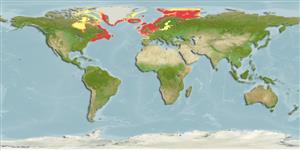
marin; saumâtre démersal; profondeur 0 - 451 m (Ref. 58496). Polar; 80°N - 40°N, 95°W - 60°E
Eastern Atlantic: south-eastern coasts of Greenland, Jan Mayen Island, Iceland to British Isles and southward to Bay of Biscay, also North Sea, Baltic Sea, Spitsbergen and southern part of Barents Sea (including White Sea). Western Atlantic: James Bay in Canada to New York, USA (Ref. 7251). Arctic Ocean.
Longueur à la première maturité / Taille / Poids / Âge
Maturité: Lm 17.8, range 15 - 30 cm
Max length : 60.0 cm TL mâle / non sexé; (Ref. 9925); common length : 24.0 cm SL mâle / non sexé; (Ref. 4698); âge max. reporté: 18 années (Ref. 122394)
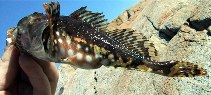
Épines dorsales (Total) : 7 - 11; Rayons mous dorsaux (Total) : 13 - 19; Épines anales: 0; Rayons mous anaux: 9 - 15; Vertèbres: 34 - 39. Caudal fin rounded. Greenish brown above, often with dark blotches and bright milky-white spots above pectoral fins; underside cherry red (males) or light orange (females) with white spots; fins with dark bands (Ref. 4698).
Body shape (shape guide): fusiform / normal.
Found on rocky bottoms with sand or mud, or among seaweeds (Ref. 4698). Benthic (Ref. 58426). Feeds on fishes, large crustaceans, occasionally polychaetes and amphipods (Ref. 4698). During the spawning season, the male's underside becomes deep red with white spots.
Eggs are deposited in a clutch on the bottom and defended by the male. Larvae hatch after about 5 weeks.
Fedorov, V.V., 1986. Cottidae. p. 1243-1260. In P.J.P. Whitehead, M.-L. Bauchot, J.-C. Hureau, J. Nielsen and E. Tortonese (eds.) Fishes of the North-eastern Atlantic and the Mediterranean. UNESCO, Paris. Vol. 3. (Ref. 4698)
Statut dans la liste rouge de l'IUCN (Ref. 130435: Version 2025-2 (Global))
Menace pour l'homme
Harmless
Utilisations par l'homme
Pêcheries: commercial; Aquarium: Aquariums publics
Outils
Articles particuliers
Télécharger en XML
Sources Internet
Estimations basées sur des modèles
Température préférée (Réf.
123201): 0.4 - 10.3, mean 4.5 °C (based on 1225 cells).
Indice de diversité phylogénétique (Réf.
82804): PD
50 = 0.5000 [Uniqueness, from 0.5 = low to 2.0 = high].
Bayesian length-weight: a=0.00871 (0.00720 - 0.01054), b=3.15 (3.09 - 3.21), in cm total length, based on LWR estimates for this species (Ref.
93245).
Niveau trophique (Réf.
69278): 3.9 ±0.0 se; based on diet studies.
Generation time: 3.1 ( na - na) years. Estimated as median ln(3)/K based on 1
growth studies.
Résilience (Réf.
120179): Milieu, temps minimum de doublement de population : 1,4 à 4,4 années (tm=2; Fec=2,742).
Vulnérabilité de la pêche (Ref.
59153): Low to moderate vulnerability (34 of 100).
🛈
Nutriments (Ref.
124155): Calcium = 85.8 [16.9, 288.9] mg/100g; Iron = 0.442 [0.184, 1.318] mg/100g; Protein = 18.9 [16.1, 21.1] %; Omega3 = 0.635 [0.263, 1.864] g/100g; Selenium = 21 [8, 53] μg/100g; VitaminA = 5.56 [1.06, 28.97] μg/100g; Zinc = 0.655 [0.268, 1.159] mg/100g (wet weight); based on
nutrient studies.