>
Scombriformes (Mackerels) >
Scombridae (Mackerels, tunas, bonitos) > Scombrinae
Etymology: Scomberomorus: Latin, scomber = mackerel + Greek, moros = silly, stupid (Ref. 45335).
Miljö: miljö / Klimatzon / djupintervall / distributionsområde
Ekologi
marina; brackvatten pelagic-neritic; havsvandrande (Ref. 51243); djupintervall 1 - 100 m (Ref. 6390), usually ? - 30 m (Ref. 6390). Tropical; 7°S - 35°S, 110°E - 157°E (Ref. 168)
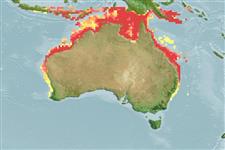
Western Pacific: largely confined to inshore coastal waters of southern Papua New Guinea and northern and eastern Australia, from Shark Bay and Onslow, Western Australia to Sydney, New South Wales. This species was confused with Scomberomorus guttatus.
Längd vid första mognad / Storlek / Vikt / Ålder
Könsmognad: Lm ?, range 48 - ? cm
Max length : 100.0 cm FL hane/ej könsbestämd; (Ref. 168); common length : 80.0 cm FL hane/ej könsbestämd; (Ref. 168); publicerad maxvikt: 12.2 kg (Ref. 3132)
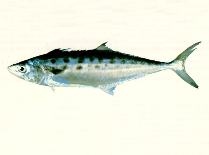
Taggstrålar i ryggfenan (totalt) : 16 - 18; Mjukstrålar i ryggfenan (totalt) : 17 - 19; Taggstrålar i analfenan: 0; Mjukstrålar i analfenan: 16 - 20; Ryggkotor: 48 - 49. Interpelvic process small and bifid. Lateral line gradually curving down toward caudal peduncle. Intestine with 2 folds and 3 limbs. Swim bladder absent. Body covered with small scales. Membrane of first dorsal fin jet black with large contrasting areas of intense white between the 6th and the last spine. Sides of adults marked with about three indefinite rows of indistinct bronze-gray blotches (absent in 9.5 cm juveniles).
Body shape (shape guide): fusiform / normal; Cross section: oval.
Schooling species which moves into inshore waters, bays and estuaries of Queensland during the southern midwinter and early spring. Often inhabit very turbid coastal waters shallower than 30 m (Ref. 6390). Common length 50 to 80 cm FL (Ref. 12241). Seasonally migratory in the Gulf of Carpentaria and form mixed schools with S. commerson over shallow reefs offshore of Queensland. Trolling lines with lures such as metal spoons and cut bait are used by recreational and commercial fishermen. Mostly marketed fresh (Ref. 9987).
Livscykel och parningsbeteende
Könsmognad | Reproduktion | Lek | Ägg | Fekunditet | Larver
Collette, B.B. and C.E. Nauen, 1983. FAO Species Catalogue. Vol. 2. Scombrids of the world. An annotated and illustrated catalogue of tunas, mackerels, bonitos and related species known to date. Rome: FAO. FAO Fish. Synop. 125(2):137 p. (Ref. 168)
Status på IUCN:s rödlista (Ref. 130435: Version 2025-2 (Global))
Hot mot människor
Reports of ciguatera poisoning (Ref. 6390)
Mänskliga användningsområden
Fiskeri: kommersiell; sportfisk: ja
Verktyg
Särskilda rapporter
Ladda ner XML
Internet-källor
Uppskattningar baserade på modeller
Önskad temperatur (Ref.
123201): 24.5 - 28.6, mean 27.4 °C (based on 302 cells).
Index för fylogenetisk mångfald (Ref.
82804): PD
50 = 0.5000 [Uniqueness, from 0.5 = low to 2.0 = high].
Bayesian length-weight: a=0.00832 (0.00379 - 0.01824), b=3.03 (2.86 - 3.20), in cm total length, based on LWR estimates for this Genus-body shape (Ref.
93245).
Trofisk nivå (Ref.
69278): 4.5 ±0.8 se; based on diet studies.
Resiliens (Ref.
120179): Mellan, lägsta populationsfördubblingstid 1,4-4,4 år (K=0.60; tm>1; tmax=10).
Sårbarhet i fisket (Ref.
59153): Low to moderate vulnerability (33 of 100).
🛈
Näringsämnen (Ref.
124155): Calcium = 38.2 [17.5, 147.4] mg/100g; Iron = 0.94 [0.43, 2.31] mg/100g; Protein = 21 [20, 22] %; Omega3 = 0.295 [0.178, 0.499] g/100g; Selenium = 66.7 [23.7, 308.3] μg/100g; VitaminA = 14.9 [2.9, 71.4] μg/100g; Zinc = 0.756 [0.504, 1.192] mg/100g (wet weight);