>
Clupeiformes (Herrings) >
Alosidae (Shads and Sardines)
Etymology: Sardina: Latin and Greek, sarda = sardine; name related to the island of Sardinia (Ref. 45335).
More on author: Walbaum.
Ambiente: milieu / zona climatica / distribuzione batimetrica / gamma di distribuzione
Ecologia
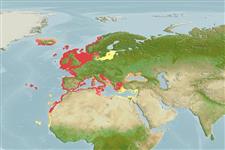
marino; salmastro pelagic-neritic; oceanodromo (Ref. 51243); distribuzione batimetrica 10 - 100 m (Ref. 5286), usually 25 - 100 m (Ref. 54866). Subtropical; 68°N - 14°N, 32°W - 43°E (Ref. 54866)
Northeast Atlantic: Iceland (rare) and North Sea, southward to Bay de Gorée, Senegal. Mediterranean (common in the western part and in Adriatic Sea, rare in the eastern part), Sea of Marmara and Black Sea.
Lunghezza alla prima maturità / Dimensione / Peso / Età
Maturità: Lm 14.8 range ? - ? cm
Max length : 27.5 cm SL maschio/sesso non determinato; (Ref. 74552); common length : 20.0 cm SL maschio/sesso non determinato; (Ref. 188); Età massima riportata: 15 anni (Ref. 35388)
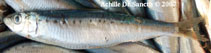
Spine dorsali (totale) : 0; Raggi dorsali molli (totale) : 13 - 21; Spine anali: 0; Raggi anali molli: 12 - 23. Body sub-cylindrical, belly rather rounded (but more compressed in juveniles). Hind margin of gill opening smoothly rounded (without fleshy outgrowths) ; 3 to 5 distinct body striae radiating downward on lower part of operculum; lower gill rakers not becoming shorter at angle of first gill arch, the upper series not overlapping the lower. Last 2 anal fin rays enlarged.
Body shape (shape guide): fusiform / normal; Cross section: compressed.
A coastal, pelagic species (Ref. 188). Form schools, usually at depths of 25 to 55 or even 100 m by day, rising to 10 to 35 m at night. Feed mainly on planktonic crustaceans, also on larger organisms. Spawn in batches (Ref. 51846), in the open sea or near the coast, producing 50,000-60,000 eggs with a mean diameter of 1.5 mm (Ref. 35388). Marketed fresh, frozen or canned. Also utilized dried or salted and smoked; can be pan-fried, broiled and microwaved (Ref. 9988).
Breeds at 20 to 25 m, near the shore or as much as 100 km out to sea.
Whitehead, P.J.P., 1985. FAO Species Catalogue. Vol. 7. Clupeoid fishes of the world (suborder Clupeoidei). An annotated and illustrated catalogue of the herrings, sardines, pilchards, sprats, shads, anchovies and wolf-herrings. FAO Fish. Synop. 125(7/1):1-303. Rome: FAO. (Ref. 188)
Stato della Lista Rossa IUCN (Ref. 130435: Version 2025-2 (Global))
Minaccia per l'uomo
Harmless
Usi umani
Pesca: elevato interesse commerciale
Strumenti
Rapporti speciali
Scarica XML
Fonti Internet
Stime basate su modelli
Temperatura preferita (Fonte Biblio.
123201): 7.1 - 17.3, mean 10.3 °C (based on 553 cells).
Indice di diversità filogenetica (Fonte Biblio.
82804): PD
50 = 1.0000 [Uniqueness, from 0.5 = low to 2.0 = high].
Bayesian length-weight: a=0.00631 (0.00554 - 0.00719), b=3.08 (3.04 - 3.12), in cm total length, based on LWR estimates for this species (Ref.
93245).
Livello trofico (Fonte Biblio.
69278): 3.1 ±0.1 se; based on diet studies.
Generation time: 3.0 (2.7 - 3.2) years. Estimated as median ln(3)/K based on 58
growth studies.
Resilienza (Fonte Biblio.
120179): Medio, tempo minimo di raddoppiamento della popolazione 1.4 - 4.4 anni (K=0.23-0.5; tm=1-2; tmax=15).
Prior r = 0.63, 95% CL = 0.41 - 0.94, Based on 26 full stock assessments.
Vulnerabilità della pesca (Ref.
59153): Low to moderate vulnerability (30 of 100).
🛈
Vulnerabilità climatica (Ref.
125649): Low vulnerability (22 of 100).
🛈
Nutrienti (Ref.
124155): Calcium = 162 [75, 357] mg/100g; Iron = 2.61 [1.10, 5.76] mg/100g; Protein = 19.8 [18.6, 21.0] %; Omega3 = 1.07 [0.55, 2.10] g/100g; Selenium = 35.9 [18.2, 74.0] μg/100g; VitaminA = 14.5 [4.5, 48.3] μg/100g; Zinc = 1.42 [1.02, 2.25] mg/100g (wet weight); based on
nutrient studies.