>
Zeiformes (Dories) >
Zeidae (Dories)
Eponymy: Derived from zaeus, an ancient Greek name for this fish dating back to Pliny’s Natural History. [...] There are many alternative names for this fish and almost as many theories as to the origin of the name. [...] (Ref. 128868), visit book page.
More on author: Linnaeus.
Entorno: milieu / zona climática / rango de profundidad / gama de distribución
Ecología
marino; salobre bentopelágico; oceanodromo (Ref. 35388); rango de profundidad 5 - 400 m (Ref. 9563), usually 50 - 150 m (Ref. 4968). Temperate; 75°N - 49°S, 17°W - 177°E (Ref. 54935)
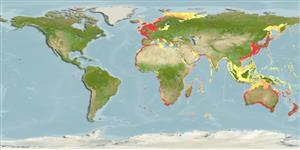
Worldwide in distribution. Eastern Atlantic: Norway to South Africa, also the Mediterranean and Black Sea. Western Pacific: Japan, Korea, Australia and New Zealand. Also known from the Indian Ocean.
Longitud en la primera madurez / Tamaño / Peso / Edad
Madurez: Lm 35.1, range 29 - 35 cm
Max length : 90.0 cm TL macho / no sexado; (Ref. 6953); common length : 40.0 cm TL macho / no sexado; (Ref. 6953); peso máximo publicado: 8.0 kg (Ref. 35388); edad máxima reportada: 12 años (Ref. 5377)
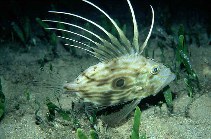
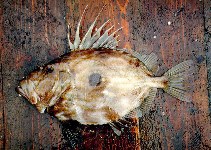
Espinas dorsales (total) : 9 - 11; Radios blandos dorsales (total) : 22 - 24; Espinas anales: 4; Radios blandos anales: 20 - 23. Gill rakers rudimentary. Minute scales present. Highly compressed body (Ref. 4253). Large dark spot, surrounded by a light ring on each side of the body (Ref. 35388).
Body shape (shape guide): short and / or deep.
Found in areas close to the sea bed (Ref. 6390). Generally solitary. Feeds mainly on schooling bony fishes, occasionally on cephalopods and crustaceans (Ref. 27121). Reproduction takes place at the end of winter and at the start of spring in the northeastern Atlantic, earlier in the Mediterranean. Eggs are pelagic, maturity reached at 4 years (Ref. 36731). Sold fresh (Ref. 9563) and frozen (Ref. 9988). Can be steamed, fried, broiled, boiled, microwaved and baked (Ref. 9988). The flesh is excellent but is utilized little in West Africa (Ref. 5377).
No studies of their reproductive development or early life history have been undertaken in Australia (Ref. 6390). Pelagic eggs (Ref. 35388).
Karrer, C. and A. Post, 1990. Zeidae. p. 631-633. In J.C. Quero, J.C. Hureau, C. Karrer, A. Post and L. Saldanha (eds.) Check-list of the fishes of the eastern tropical Atlantic (CLOFETA). JNICT, Lisbon; SEI, Paris; and UNESCO, Paris. Vol. 2. (Ref. 6953)
Situación en la Lista Roja de la UICN (Ref. 130435: Version 2025-2 (Global))
Amenaza para el ser humano
Harmless
Usos humanos
Pesquerías: comercial; pesca deportiva: si; Acuario: Acuarios públicos
Herramientas
Informes especiales
Descargar XML
Fuentes de Internet
Estimaciones basadas en modelos
Temperatura preferida (Referencia
123201): 6.7 - 23.7, mean 13.6 °C (based on 1223 cells).
Índice de diversidad filogenética (Referencia
82804): PD
50 = 0.7656 [Uniqueness, from 0.5 = low to 2.0 = high].
Bayesian length-weight: a=0.01585 (0.01311 - 0.01916), b=2.92 (2.86 - 2.98), in cm total length, based on LWR estimates for this species (Ref.
93245).
Nivel trófico (Referencia
69278): 4.5 ±0.8 se; based on diet studies.
Resiliencia (Referencia
120179): Medio, población duplicada en un tiempo mínimo de 1.4-4.4 años (K=0.15; tm=3-4; tmax=12).
Prior r = 0.74, 95% CL = 0.49 - 1.10, Based on 1 full stock assessment.
Vulnerabilidad pesquera (Ref.
59153): Moderate vulnerability (39 of 100).
🛈
Vulnerabilidad climática (Ref.
125649): Moderate vulnerability (38 of 100).
🛈
Nutrientes (Ref.
124155): Calcium = 14.1 [8.1, 27.2] mg/100g; Iron = 0.246 [0.139, 0.432] mg/100g; Protein = 19.2 [16.0, 21.6] %; Omega3 = 0.65 [0.34, 1.23] g/100g; Selenium = 21 [10, 42] μg/100g; VitaminA = 16.8 [4.4, 66.5] μg/100g; Zinc = 0.368 [0.254, 0.546] mg/100g (wet weight); based on
nutrient studies.