>
Eupercaria/misc (Various families in series Eupercaria) >
Haemulidae (Grunts) > Haemulinae
Etymology: Haemulon: Greek, haimaleos = bloody (Ref. 45335).
Eponymy: Samuel Hubbard Scudder (1837–1911) was an American entomologist and palaeontologist. [...] (Ref. 128868), visit book page.
More on author: Gill.
Environnement : milieu / zone climatique / profondeur / gamme de distribution
Écologie
marin récifal; profondeur 3 - 40 m (Ref. 5227), usually 3 - 12 m (Ref. 5227). Tropical; 27°N - 2°S
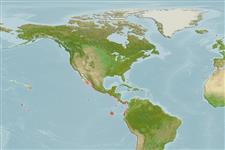
Eastern Pacific: Mexico to Ecuador, including the Galapagos Islands.
Taille / Poids / Âge
Maturité: Lm ? range ? - ? cm
Max length : 35.0 cm TL mâle / non sexé; (Ref. 9114); common length : 30.0 cm TL mâle / non sexé; (Ref. 9114)
Description synthétique
Clés d'identification | Morphologie | Morphométrie
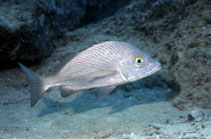
Body oblong, compressed, and deep (depth contained 2.3 to 2.7 times in standard length); mouth large and terminal, its posterior end located at the same level as the anterior edge of the pupil; first gill arch with 15 to 22 gill rakers; dorsal fin notched, with 11 to 12 spines and 14 to 17 soft rays (XI-XII, 14-17); second anal spine slightly longer and stronger than third; scale series above lateral line oblique; body silvery gray; each scale bearing a dark spot;; the spots appearing to form lines following the scale series; fins charcoal gray (Ref.. 55763).
Forms schools above rocky, boulder strewn reefs, slopes, and hard substrate with good water movement (Ref. 5227).
Cycle de vie et comportement reproducteur
Maturité | Reproduction | Frai | Œufs | Fécondité | Larves
Oviparous, distinct pairing during breeding (Ref. 205).
McKay, R.J. and M. Schneider, 1995. Haemulidae. Burros, corocoros, chulas, gallinazos, roncos. p. 1136-1173. In W. Fischer, F. Krupp, W. Schneider, C. Sommer, K.E. Carpenter and V. Niem (eds.) Guia FAO para Identification de Especies para lo Fines de la Pesca. Pacifico Centro-Oriental. 3 Vols. FAO, Rome. (Ref. 9114)
Statut dans la liste rouge de l'IUCN (Ref. 130435: Version 2025-2 (Global))
Menace pour l'homme
Harmless
Utilisations par l'homme
Pêcheries: commercial
Outils
Articles particuliers
Télécharger en XML
Sources Internet
Estimations basées sur des modèles
Température préférée (Réf.
123201): 23.2 - 29.1, mean 27.4 °C (based on 195 cells).
Indice de diversité phylogénétique (Réf.
82804): PD
50 = 0.5000 [Uniqueness, from 0.5 = low to 2.0 = high].
Bayesian length-weight: a=0.01479 (0.00645 - 0.03393), b=3.03 (2.84 - 3.22), in cm total length, based on LWR estimates for this Genus-body shape (Ref.
93245).
Niveau trophique (Réf.
69278): 4.2 ±0.73 se; based on food items.
Résilience (Réf.
120179): Milieu, temps minimum de doublement de population : 1,4 à 4,4 années (Preliminary K or Fecundity.).
Vulnérabilité de la pêche (Ref.
59153): Low vulnerability (25 of 100).
🛈
Nutriments (Ref.
124155): Calcium = 38.3 [16.0, 79.6] mg/100g; Iron = 0.603 [0.289, 1.123] mg/100g; Protein = 18.9 [17.0, 20.9] %; Omega3 = 0.11 [0.05, 0.21] g/100g; Selenium = 28.9 [15.0, 56.1] μg/100g; VitaminA = 102 [32, 321] μg/100g; Zinc = 0.843 [0.533, 1.319] mg/100g (wet weight);