>
Eupercaria/misc (Various families in series Eupercaria) >
Haemulidae (Grunts) > Haemulinae
Etymology: Haemulon: Greek, haimaleos = bloody (Ref. 45335).
More on author: Gill.
Environnement : milieu / zone climatique / profondeur / gamme de distribution
Écologie
marin récifal; profondeur 3 - 30 m (Ref. 5227), usually 10 - 12 m (Ref. 5227). Tropical; 28°N - 7°N
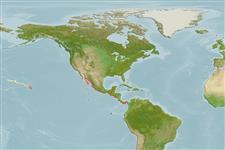
Eastern Central Pacific: Gulf of California to Panama.
Taille / Poids / Âge
Maturité: Lm ? range ? - ? cm
Max length : 71.0 cm TL mâle / non sexé; (Ref. 55763); common length : 30.0 cm TL mâle / non sexé; (Ref. 55763); poids max. publié: 2.3 kg (Ref. 40926)
Description synthétique
Clés d'identification | Morphologie | Morphométrie
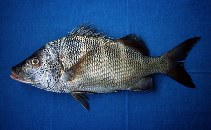
Body oblong, compressed and not very deep (depth contained 2.9 to 3.3 times in standard length ); mouth large and terminal, its posterior end located under the anterior rim of the eye; first gill arch with 18 to 22 gill rakers; dorsal fin notched, with 11 to 12 spines and 16 to 18 soft rays (XI-XII, 16-18); second anal spine slightly longer and stronger than third; scale series above lateral line oblique; juveniles with 3 vertical bars and a caudal spot that disappears with age; adults with 6 or 7 dark gray vertical bars on a yellowish body; head with a dark spot behind the eye (Ref. 55763).
Body shape (shape guide): fusiform / normal.
Forms schools in coastal reefs during the day but disperses at night in search for food. Often feed by digging in sand (Ref. 5227).
Cycle de vie et comportement reproducteur
Maturité | Reproduction | Frai | Œufs | Fécondité | Larves
Oviparous, distinct pairing during breeding (Ref. 205).
McKay, R.J. and M. Schneider, 1995. Haemulidae. Burros, corocoros, chulas, gallinazos, roncos. p. 1136-1173. In W. Fischer, F. Krupp, W. Schneider, C. Sommer, K.E. Carpenter and V. Niem (eds.) Guia FAO para Identification de Especies para lo Fines de la Pesca. Pacifico Centro-Oriental. 3 Vols. FAO, Rome. (Ref. 9114)
Statut dans la liste rouge de l'IUCN (Ref. 130435: Version 2025-2 (Global))
Menace pour l'homme
Harmless
Utilisations par l'homme
Pêcheries: intérêt commercial mineur
Outils
Articles particuliers
Télécharger en XML
Sources Internet
Estimations basées sur des modèles
Température préférée (Réf.
123201): 22.9 - 29.1, mean 28 °C (based on 149 cells).
Indice de diversité phylogénétique (Réf.
82804): PD
50 = 0.5000 [Uniqueness, from 0.5 = low to 2.0 = high].
Bayesian length-weight: a=0.02570 (0.01537 - 0.04300), b=3.01 (2.87 - 3.15), in cm total length, based on LWR estimates for this species & Genus-body shape (Ref.
93245).
Niveau trophique (Réf.
69278): 4.2 ±0.73 se; based on food items.
Generation time: 8.3 ( na - na) years. Estimated as median ln(3)/K based on 1
growth studies.
Résilience (Réf.
120179): Faible, temps minimum de doublement de population : 4,5 à 14 années (K=0.13).
Vulnérabilité de la pêche (Ref.
59153): High vulnerability (58 of 100).
🛈
Nutriments (Ref.
124155): Calcium = 26.6 [9.7, 51.1] mg/100g; Iron = 0.52 [0.26, 0.95] mg/100g; Protein = 19.4 [17.5, 21.2] %; Omega3 = 0.118 [0.064, 0.199] g/100g; Selenium = 30.9 [16.3, 56.9] μg/100g; VitaminA = 121 [44, 318] μg/100g; Zinc = 0.879 [0.599, 1.285] mg/100g (wet weight);