>
Eupercaria/misc (Various families in series Eupercaria) >
Gerreidae (Mojarras)
Etymology: Eucinostomus: Greek, eu = good + Greek, kyon = dog + Greek, stoma = mouth (Ref. 45335).
Eponymy: Howard Wesley Curran is a biologist whose PhD dissertation: A systematic revision of the gerrid fishes referred to the genus Eucinostomus, with a discussion of their distribution and speciation (1942) concerned the same genus of fish. [...] (Ref. 128868), visit book page.
Umwelt: Milieu / Klimazone / Tiefenbereich / Verbreitungsgebiet
Ökologie
seewasser; süßwasser; brackwasser demersal; tiefenbereich 10 - 60 m (Ref. 91172). Tropical; 26°C - 32°C (Ref. 36880); 37°N - 3°S, 115°W - 77°W
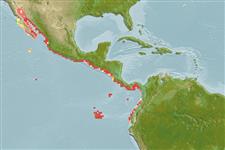
Eastern Pacific: Baja California, Mexico and the Gulf of California to the northern tip of Peru, including the Cocos and the Galapagos Islands.
Größe / Gewicht / Alter
Geschlechtsreife: Lm ? range ? - ? cm
Max length : 21.0 cm TL Männchen/unbestimmt; (Ref. 38398)
Kurzbeschreibung
Bestimmungsschlüssel | Morphologie | Morphometrie
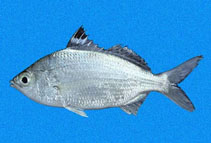
Found over soft bottoms of coastal waters. Juveniles are commonly found in estuarine regions, mangroves, tidal streams and rivers far from the coast. Adults occur in deeper waters. Forms schools (Ref. 37955). Omnivore (Ref. 37955), feeds on vegetable matter, micro-invertebrates and detritus (Ref. 36880).
Lebenszyklus und Paarungsverhalten
Geschlechtsreife | Fortpflanzung | Ablaichen | Eier | Fruchtbarkeit | Larven
Bussing, W.A., 1995. Gerreidae. Mojarras. p. 1114-1128. In W. Fischer, F. Krupp, W. Schneider, C. Sommer, K.E. Carpenter and V. Niem (eds.) Guia FAO para Identification de Especies para lo Fines de la Pesca. Pacifico Centro-Oriental. 3 Vols. FAO, Rome. (Ref. 9303)
IUCN Rote Liste Status (Ref. 130435: Version 2025-2 (Global))
Bedrohung für Menschen
Harmless
Nutzung durch Menschen
Fischereien: weniger kommerziell; Köder: occasionally
Tools
Zusatzinformationen
Download XML
Internet Quellen
Schätzungen auf der Grundlage von Modellen
Bevorzugte Temperatur (Ref.
123201): 20.6 - 28.9, mean 25.9 °C (based on 70 cells).
Phylogenetischer Diversitätsindex (Ref.
82804): PD
50 = 0.5010 [Uniqueness, from 0.5 = low to 2.0 = high].
Bayesian length-weight: a=0.01318 (0.01083 - 0.01605), b=3.05 (3.00 - 3.10), in cm total length, based on LWR estimates for this species (Ref.
93245).
Trophische Ebene (Ref.
69278): 3.2 ±0.3 se; based on size and trophs of closest relatives
Widerstandsfähigkeit (Ref.
120179): hoch, Verdopplung der Population dauert weniger als 15 Monate. (Preliminary K or Fecundity.).
Anfälligkeit der Fischerei (Ref.
59153): Low vulnerability (11 of 100).
🛈