>
Blenniiformes (Blennies) >
Blenniidae (Combtooth blennies) > Blenniinae
Etymology: Petroscirtes: Latin, petra, -ae = stone + Greek, skirteo = to jump.
Umwelt: Milieu / Klimazone / Tiefenbereich / Verbreitungsgebiet
Ökologie
seewasser; brackwasser benthopelagisch; tiefenbereich 1 - 10 m (Ref. 86942). Subtropical
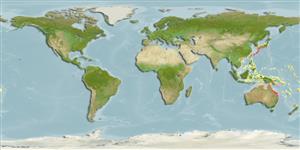
Western Pacific: Queensland, New South Wales, Lord Howe Island, Australia and New Caledonia.
Größe / Gewicht / Alter
Geschlechtsreife: Lm ? range ? - ? cm
Max length : 13.0 cm TL Männchen/unbestimmt; (Ref. 2334)
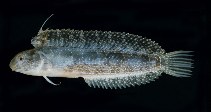
Rückenflossenstacheln (insgesamt) : 11; Rückenflossenweichstrahlen (insgesamt) : 19 - 20; Afterflossenstacheln: 2; Afterflossenweichstrahlen: 18 - 20. Jaw teeth incisiform, rigid, close-set, increasing with age; large, curved canine tooth on each side at posterior of lower jaw, and smaller canine on each side at posterior of upper jaw (similar dentition shared within genera); lower end of gill opening above level of pectoral-fin base (also a shared character within genera); small unbranched cirrus on each side of chin; with or without small supraorbital and nuchal cirri; body depth at anal-fin origin 4.5-7.0 SL; males with elongated second dorsal spine; unnotched dorsal fin; caudal fin interradial membranes slightly incised, notably in males; ground color variable with habitat, gray, brown, or green, with 6 large, uneven dark blotches on upper side and numerous white dots and dashes and, ventrally, dark dots. Anal soft rays rarely 18; pectoral soft rays typically 14; segmented caudal rays 1, unbranched (Ref. 54980).
Body shape (shape guide): elongated.
Adults hide in seagrasses, seaweeds, or empty mollusk shells. Oviparous (Ref. 205). Mature females lay eggs on the inner surface of dead bivalve shells which are guarded by the male (Ref. 2334). Larvae are planktonic, often found in shallow, coastal waters (Ref. 94114).
Lebenszyklus und Paarungsverhalten
Geschlechtsreife | Fortpflanzung | Ablaichen | Eier | Fruchtbarkeit | Larven
Oviparous, distinct pairing (Ref. 205).
Randall, J.E., G.R. Allen and R.C. Steene, 1990. Fishes of the Great Barrier Reef and Coral Sea. University of Hawaii Press, Honolulu, Hawaii. 506 p. (Ref. 2334)
IUCN Rote Liste Status (Ref. 130435: Version 2025-2 (Global))
Bedrohung für Menschen
Harmless
Nutzung durch Menschen
Tools
Zusatzinformationen
Download XML
Internet Quellen
Schätzungen auf der Grundlage von Modellen
Bevorzugte Temperatur (Ref.
123201): 21.2 - 28, mean 26 °C (based on 599 cells).
Phylogenetischer Diversitätsindex (Ref.
82804): PD
50 = 0.5005 [Uniqueness, from 0.5 = low to 2.0 = high].
Bayesian length-weight: a=0.00575 (0.00255 - 0.01297), b=3.06 (2.87 - 3.25), in cm total length, based on LWR estimates for this (Sub)family-body shape (Ref.
93245).
Trophische Ebene (Ref.
69278): 2.1 ±0.2 se; based on size and trophs of closest relatives
Widerstandsfähigkeit (Ref.
120179): hoch, Verdopplung der Population dauert weniger als 15 Monate. (Preliminary K or Fecundity.).
Anfälligkeit der Fischerei (Ref.
59153): Low vulnerability (10 of 100).
🛈
Nährstoffe (Ref.
124155): Calcium = 176 [81, 359] mg/100g; Iron = 1.11 [0.63, 2.17] mg/100g; Protein = 17.5 [16.5, 18.6] %; Omega3 = 0.196 [0.089, 0.417] g/100g; Selenium = 16.6 [7.1, 38.8] μg/100g; VitaminA = 25.1 [7.4, 84.6] μg/100g; Zinc = 2.05 [1.34, 3.10] mg/100g (wet weight);