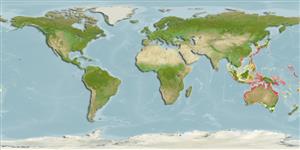
Umwelt: Milieu / Klimazone / Tiefenbereich / Verbreitungsgebiet
Ökologie
seewasser; brackwasser riff-verbunden. Tropical
Western Pacific: Queensland to western Australia (Ref. 2334).
Größe / Gewicht / Alter
Geschlechtsreife: Lm ? range ? - ? cm
Max length : 15.0 cm TL Männchen/unbestimmt; (Ref. 2334); 10.6 cm SL (female)
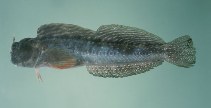
Rückenflossenstacheln (insgesamt) : 12 - 14; Rückenflossenweichstrahlen (insgesamt) : 17 - 21; Afterflossenstacheln: 2; Afterflossenweichstrahlen: 17 - 21. Dorsal fin XII-XIV, 17-21; notched membrane between spinous and segmented-ray of the dorsal fin >75% the length of the first segmented ray; posterior membrane from posteriormost ray beginning somewhere between the dorsal edge of caudal peduncle, anterior to caudal-fin base, to dorsal margin of caudal fin <15% of caudal-fin length, typically on caudal peduncle, rarely posteriorly past the vertical at caudal-fin base; segmented anal fin rays 17-21; pectoral-fin rays 12-15; vertebrae 11 or 12+24 to 28 = 35-39 (usually 37 or 38); nape cirrus present or absent bilaterally or unilaterally, with slight variations between populations; orbital cirrus tree-like with medial and lateral branches; nasal cirri on rim of each anterior nostril short, palmate, with 2-8 branches (typically <6); bi-pored lateral-line tubes often more than 18; membrane from last dorsal-fin ray usually attached to caudal peduncle at or anterior to caudal-fin base; body with numerous small, pale spots; lateral line canal continuous antedorsally with simple pores (no vertical pairs of pores), extending posteriorly to point between verticals from 8th and 13th (rarely only to 8th) dorsal-fin spines, descending to midside and, in specimens >3 cm SL, continuing posteriorly as series of 6 to 26 short, disconnected, horizontally bi-pored canals/tubes in skin, numbering typically more than 10 and higher, proportional to SL; mandibular pores 4-6; lacking posterior canines; ventral margin of upper lip crenulate; no canine teeth present in lower jaw; both sexes with fleshy, blade-like crest on dorsal part of head; spinous- and segmented-ray portions of dorsal fin faintly to darkly dusky, often bearing dark, slender, oblique stripes (males) or dark spots (females). Largest male 11.8 cm SL; largest female 10.6 cm SL. With ophioblennius stage.
Body shape (shape guide): elongated.
Facultative air-breathing (Ref. 126274); Adults occur along rocky and mangrove shores (Ref. 2334); in shallow depths and perhaps, under brackish or freshwater conditions (Ref. 9962). Oviparous. Eggs are demersal and adhesive (Ref. 205), and are attached to the substrate via a filamentous, adhesive pad or pedestal (Ref. 94114). Larvae are planktonic, often found in shallow, coastal waters (Ref. 94114).
Lebenszyklus und Paarungsverhalten
Geschlechtsreife | Fortpflanzung | Ablaichen | Eier | Fruchtbarkeit | Larven
Oviparous, distinct pairing (Ref. 205).
Springer, V.G. and J.T. Williams, 1994. The Indo-West Pacific blenniid fish genus Istiblennius reappraised: a revision of Istiblennius, Blenniella, and Paralticus, new genus. Smithson. Contrib. Zool. 565:1-193. (Ref. 9962)
IUCN Rote Liste Status (Ref. 130435: Version 2025-2 (Global))
Bedrohung für Menschen
Harmless
Nutzung durch Menschen
Fischereien: nicht kommerziell
Tools
Zusatzinformationen
Download XML
Internet Quellen
Schätzungen auf der Grundlage von Modellen
Bevorzugte Temperatur (Ref.
123201): 22.2 - 29.3, mean 27.3 °C (based on 920 cells).
Phylogenetischer Diversitätsindex (Ref.
82804): PD
50 = 0.5001 [Uniqueness, from 0.5 = low to 2.0 = high].
Bayesian length-weight: a=0.00776 (0.00354 - 0.01702), b=3.00 (2.81 - 3.19), in cm total length, based on LWR estimates for this (Sub)family-body shape (Ref.
93245).
Trophische Ebene (Ref.
69278): 2.0 ±0.00 se; based on food items.
Widerstandsfähigkeit (Ref.
120179): hoch, Verdopplung der Population dauert weniger als 15 Monate. (Preliminary K or Fecundity.).
Anfälligkeit der Fischerei (Ref.
59153): Low vulnerability (10 of 100).
🛈
Nährstoffe (Ref.
124155): Calcium = 130 [56, 228] mg/100g; Iron = 0.739 [0.397, 1.359] mg/100g; Protein = 18.3 [17.0, 19.5] %; Omega3 = 0.0708 [, ] g/100g; Selenium = 17 [8, 39] μg/100g; VitaminA = 98.2 [25.0, 375.3] μg/100g; Zinc = 2.82 [1.81, 4.38] mg/100g (wet weight);