Klassifizierung / Names
Namen | Synonyme | Catalog of Fishes(Gattung, Arten) | ITIS | CoL | WoRMS | Cloffa
>
Holocentriformes (Squirrelfishes, soldierfishes) >
Holocentridae (Squirrelfishes, soldierfishes) > Holocentrinae
Etymology: Sargocentron: Greek, sargos = sargus + Greek, kentron = sting (Ref. 45335).
More on author: Gill.
Umwelt: Milieu / Klimazone / Tiefenbereich / Verbreitungsgebiet
Ökologie
seewasser demersal. Tropical; 28°N - 2°S
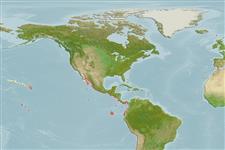
Eastern Pacific: Gulf of California to Ecuador, including the Galapagos Islands.
Größe / Gewicht / Alter
Geschlechtsreife: Lm ? range ? - ? cm
Max length : 25.4 cm TL Männchen/unbestimmt; (Ref. 9307); common length : 15.0 cm TL Männchen/unbestimmt; (Ref. 55763)
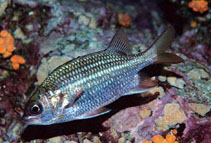
Rückenflossenstacheln (insgesamt) : 11; Rückenflossenweichstrahlen (insgesamt) : 13 - 14; Afterflossenstacheln: 4; Afterflossenweichstrahlen: 8 - 9; Wirbelzahl: 27. Body deep and somewhat compressed; caudal peduncle narrow; eyes large; pelvic fins with 1 spine and 7 soft rays (I, 7); preopercle with small serrations and a large, pointed spine at the angle; body violet pink; back bronze (Ref. 55763). Branchiostegal rays: 8-8 (Ref. 36626).
Body shape (shape guide): fusiform / normal.
Adults hide in small caves or in crevices and cracks of rocks during the day. At night, they feed on small crustaceans in the intertidal zone, less than 3 m in depth. Oviparous, with planktonic larvae (Ref. 36626). Appear only occasionally in markets where it is sold fresh.
Lebenszyklus und Paarungsverhalten
Geschlechtsreife | Fortpflanzung | Ablaichen | Eier | Fruchtbarkeit | Larven
Schneider, W. and F. Krupp, 1995. Holocentridae. Candiles. p. 1182-1185. In W. Fischer, F. Krupp, W. Schneider, C. Sommer, K.E. Carpenter and V. Niem (eds.) Guia FAO para Identification de Especies para lo Fines de la Pesca. Pacifico Centro-Oriental. 3 Vols. FAO, Rome. (Ref. 9307)
IUCN Rote Liste Status (Ref. 130435: Version 2025-2 (Global))
Bedrohung für Menschen
Harmless
Nutzung durch Menschen
Fischereien: bycatch
Tools
Zusatzinformationen
Download XML
Internet Quellen
Schätzungen auf der Grundlage von Modellen
Bevorzugte Temperatur (Ref.
123201): 23.2 - 29.1, mean 27.3 °C (based on 214 cells).
Phylogenetischer Diversitätsindex (Ref.
82804): PD
50 = 0.5000 [Uniqueness, from 0.5 = low to 2.0 = high].
Bayesian length-weight: a=0.01698 (0.00810 - 0.03560), b=2.96 (2.79 - 3.13), in cm total length, based on LWR estimates for this Genus-body shape (Ref.
93245).
Trophische Ebene (Ref.
69278): 3.5 ±0.48 se; based on food items.
Widerstandsfähigkeit (Ref.
120179): hoch, Verdopplung der Population dauert weniger als 15 Monate. (Preliminary K or Fecundity.).
Anfälligkeit der Fischerei (Ref.
59153): Low vulnerability (15 of 100).
🛈
Nährstoffe (Ref.
124155): Calcium = 149 [50, 804] mg/100g; Iron = 0.959 [0.375, 2.974] mg/100g; Protein = 17.8 [16.8, 18.8] %; Omega3 = 0.251 [0.102, 0.617] g/100g; Selenium = 60.1 [31.2, 111.9] μg/100g; VitaminA = 19.3 [7.6, 47.8] μg/100g; Zinc = 1.79 [0.79, 3.50] mg/100g (wet weight);