>
Tetraodontiformes (Puffers and filefishes) >
Monacanthidae (Filefishes)
Etymology: Cantheschenia: Greek, kanthos = the outer or inner corner of the eye, where the lids meet, 1646 + Greek, schein, eko = to carry (Ref. 45335); grandisquamis: Name from the Latin word 'grandisquamis' (meaning large-scale), for the relatively large prominently outlined scales on the mid-side of the body.
Environnement : milieu / zone climatique / profondeur / gamme de distribution
Écologie
marin récifal; profondeur ? - 29 m (Ref. 58018). Temperate
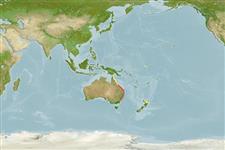
Western Pacific: Capricorn Group to New South Wales, Australia.
Taille / Poids / Âge
Maturité: Lm ? range ? - ? cm
Max length : 26.0 cm TL mâle / non sexé; (Ref. 2334)
Description synthétique
Clés d'identification | Morphologie | Morphométrie
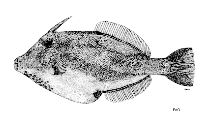
Rayons mous dorsaux (Total) : 39; Rayons mous anaux: 36; Vertèbres: 19. Diagnosis: Relatively large scales on side of body with prominent outlines forming a reticulate pattern, each scale with many small spinules arranged in series radiating from a slightly larger central spinule. Soft dorsal rays 39, anal rays 36, pectoral rays 13. Color pattern consists of a dark brown to yellowish brown background with a patch of iridescent blue spots on side of throat and breast; a similarly colored line along basal sheath of both soft dorsal and anal fins, and upper and lower 4 rays of caudal fin dark blue, with a black bar along posterior margin, the remainder of fin yellow-orange (Ref. 35708).
Body shape (shape guide): short and / or deep; Cross section: compressed.
In sheltered coastal and offshore reefs. Uncommon (Ref. 9710).
Cycle de vie et comportement reproducteur
Maturité | Reproduction | Frai | Œufs | Fécondité | Larves
Randall, J.E., G.R. Allen and R.C. Steene, 1990. Fishes of the Great Barrier Reef and Coral Sea. University of Hawaii Press, Honolulu, Hawaii. 506 p. (Ref. 2334)
Statut dans la liste rouge de l'IUCN (Ref. 130435: Version 2025-2 (Global))
Menace pour l'homme
Harmless
Utilisations par l'homme
Outils
Articles particuliers
Télécharger en XML
Sources Internet
Estimations basées sur des modèles
Température préférée (Réf.
123201): 21.4 - 26.7, mean 25.2 °C (based on 181 cells).
Indice de diversité phylogénétique (Réf.
82804): PD
50 = 0.7500 [Uniqueness, from 0.5 = low to 2.0 = high].
Bayesian length-weight: a=0.01905 (0.00905 - 0.04012), b=2.93 (2.75 - 3.11), in cm total length, based on LWR estimates for this (Sub)family-body shape (Ref.
93245).
Niveau trophique (Réf.
69278): 2.9 ±0.4 se; based on size and trophs of closest relatives
Résilience (Réf.
120179): Milieu, temps minimum de doublement de population : 1,4 à 4,4 années (Preliminary K or Fecundity.).
Vulnérabilité de la pêche (Ref.
59153): Low vulnerability (16 of 100).
🛈
Nutriments (Ref.
124155): Calcium = 16.4 [6.1, 44.0] mg/100g; Iron = 0.236 [0.106, 0.577] mg/100g; Protein = 18.3 [16.0, 20.5] %; Omega3 = 0.256 [0.105, 0.555] g/100g; Selenium = 6.65 [2.66, 17.94] μg/100g; VitaminA = 39.9 [8.5, 197.8] μg/100g; Zinc = 0.645 [0.383, 1.122] mg/100g (wet weight);