Lumpenus lampretaeformis, Snakeblenny

You can sponsor this page

Lumpenus lampretaeformis (Walbaum, 1792)

Snakeblenny
Beobachtung melden im Fish Watcher
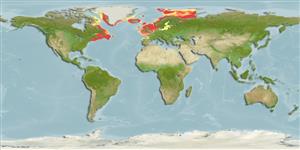
Native range
This map was computer-generated and has not yet been reviewed.
Lumpenus lampretaeformis   AquaMaps   Data sources: GBIF OBIS
Hochladen Photos und videos
Bilder | videos | Google Bild
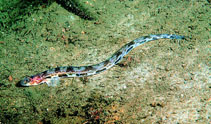
Image of Lumpenus lampretaeformis (Snakeblenny)
Lumpenus lampretaeformis
Photo von Svensen, E.

Klassifizierung / Names Namen | Synonyme | Catalog of Fishes(Gattung, Arten) | ITIS | CoL | WoRMS | Cloffa

> Perciformes/Zoarcoidei (Eelpouts and pricklebacks) > Lumpenidae (Eel pricklebacks)
Etymology: Lumpenus: Latin, lumpus, an uncouthlooking spiny-finned fish of a leaden-blue colour (Ref. 45335).
More on author: Walbaum.

Umwelt: Milieu / Klimazone / Tiefenbereich / Verbreitungsgebiet Ökologie

seewasser demersal; standorttreu (Ref. 88171); tiefenbereich 30 - 373 m (Ref. 58426), usually 40 - 100 m (Ref. 51666). Temperate; 8°C - 14°C (Ref. 89228); 80°N - 41°N, 71°W - 55°E

Verbreitung Territorien | FAO Gebiete | Ökosysteme | Vorkommen | Punkt Karte | Einführungen | Faunafri

North Atlantic: Spitsbergen southward to Scandinavian coasts, North Sea, southern part of the Baltic, the Faroes, Iceland and south-eastern coasts of Greenland. Elsewhere, western coasts of Greenland; also, Labrador and Newfoundland to Massachusetts Bay (subspecies Lumpenus lumpretaeformis serpentinus Storer, Ref. 51666).

Länge bei der ersten Reifung / Größe / Gewicht / Alter

Geschlechtsreife: Lm 20.0  range ? - ? cm
Max length : 50.0 cm TL Männchen/unbestimmt; (Ref. 35388)

Kurzbeschreibung Bestimmungsschlüssel | Morphologie | Morphometrie

Elongated, eel-like fish with a pointed caudal fin. A single dorsal fin extends almost throughout the entire length of the body. The anal fin covers about two-thirds of the total length. Pale brown dorsally, becoming bluish on the sides, and greenish-yellow ventrally. There are numerous irregular brown patches on the body (Ref. 35388).
Body shape (shape guide): eel-like.

Biologie     Fachlexikon (Englisch) (z.B. epibenthic)

A benthic species (Ref. 58426), living in Y-shaped tubes in the mud in 50-200 m depth (Ref. 35388). The burrows are believed to be used for parental care of the eggs (Ref. 80819) . Feeds on small crustaceans, mollusks, brittle stars and worms (Ref. 5204). Matures at 3 years with about 20 cm length. Spawning takes place in December - January, 1,000 eggs are laid on the sea floor, in deep water (Ref. 35388). Isolated population in the Baltic Sea is probably a relict from the last ice age (Ref. 35388) that reached the Baltic Sea during the early saltwater stage of the sea (Ref. 82152; 82153).

Lebenszyklus und Paarungsverhalten Geschlechtsreife | Fortpflanzung | Ablaichen | Eier | Fruchtbarkeit | Larven

Hauptreferenz Laden Sie Ihre Referenzen hoch | Referenzen | Koordinator | Partner

Wheeler, A., 1992. A list of the common and scientific names of fishes of the British Isles. J. Fish Biol. 41(suppl.A):1-37. (Ref. 5204)

IUCN Rote Liste Status (Ref. 130435: Version 2025-2 (Global))


CITES

Not Evaluated

CMS (Ref. 116361)

Not Evaluated

Bedrohung für Menschen

  Harmless


Nutzung durch Menschen

Fischereien: nicht kommerziell
FAO - Publication: search | FishSource | Das Meer um uns herum

Mehr Information

Trophische Ökologie
Lebensmittel (Beutetiere)
Nahrungszusammensetzung
Nahrungsaufnahme
Lebensmittelrationen
Räuber
Ökologie
Ökologie
Lebenszyklus
Fortpflanzung
Geschlechtsreife
Reifung/Kiemen rel.
Fruchtbarkeit
Ablaichen
Laichaggregationen
Eier
Eientwicklung
Larven
Larven Pop.Dyn.
Verbreitung
Territorien
FAO Gebiete
Ökosysteme
Vorkommen
Einführungen
BRUVS - Videos
Anatomie
Kiemenoberfläche
Gehirn
Otolith
Physiologie
Körperliche Zusammensetzung
Nährstoffe
Sauerstoffverbrauch
Schwimmart
Schwimmgeschwindigkeit
Visuelle Pigmente
Fischgeräusche
Krankheiten und Parasiten
Toxizität (LC50s)
Genetik
Genom
Genetik
Heterozygotie
Vererbbarkeit
Genetische Vielfalt
Menschenbezogen
Aquakultur-Systeme
Aquakultur Profile
Zuchtlinien
Ciguatera-Fälle
Briefmarken, Münzen, Verschiedenes.
Aufsuchen
Partner
Referenzen
Referenzen

Tools

Zusatzinformationen

Download XML

Internet Quellen

AFORO (otoliths) | Aquatic Commons | BHL | Cloffa | Websites from users | FishWatcher Einträge suchen | CISTI | Catalog of Fishes: Gattung, Arten | DiscoverLife | ECOTOX | FAO - Publication: search | Faunafri | Fishipedia | Fishtrace | GloBI | Google Books | Google Scholar | Google | IGFA World Record | Nationale Datenbanken | OneZoom | Open Tree of Life | Otolith Atlas of Taiwan Fishes | PubMed | Reef Life Survey | Socotra Atlas | TreeBase | Tree of Life | Wikipedia: Gehe zu, Suchen | World Records Freshwater Fishing | Zoologischer Rekord

Schätzungen auf der Grundlage von Modellen

Bevorzugte Temperatur (Ref. 123201): 0.4 - 8.5, mean 3.1 °C (based on 420 cells).
Phylogenetischer Diversitätsindex (Ref. 82804):  PD50 = 0.6255   [Uniqueness, from 0.5 = low to 2.0 = high].
Bayesian length-weight: a=0.00129 (0.00051 - 0.00326), b=2.98 (2.75 - 3.21), in cm total length, based on LWR estimates for this (Sub)family-body shape (Ref. 93245).
Trophische Ebene (Ref. 69278):  3.6   ±0.48 se; based on food items.
Generation time: 5.4 ( na - na) years. Estimated as median ln(3)/K based on 1 growth studies.
Widerstandsfähigkeit (Ref. 120179):  mittel, Verdopplung der Population dauert 1,4 - 4,4 Jahre. (K=0.20; tmax=9;).
Anfälligkeit der Fischerei (Ref. 59153):  Moderate to high vulnerability (50 of 100). 🛈
Nährstoffe (Ref. 124155):  Calcium = 36.8 [21.4, 62.1] mg/100g; Iron = 0.32 [0.19, 0.54] mg/100g; Protein = 18.7 [16.4, 20.7] %; Omega3 = 0.439 [0.247, 0.728] g/100g; Selenium = 19.1 [10.2, 35.5] μg/100g; VitaminA = 12.9 [3.9, 41.6] μg/100g; Zinc = 0.527 [0.387, 0.735] mg/100g (wet weight);