>
Eupercaria/misc (Various families in series Eupercaria) >
Lutjanidae (Snappers) > Lutjaninae
Etymology: Hoplopagrus: Greek, hoplon = weapon + Greek, pagros = a fish, Dentex sp. (Ref. 45335).
Eponymy: Dr Albert Karl Ludwig Gotthilf Günther (1830–1914) was a German-born British zoologist, ichthyologist and herpetologist. [...] (Ref. 128868), visit book page.
More on author: Gill.
Ambiente: milieu / zona climática / intervalo de profundidade / gama de distribuição
Ecologia
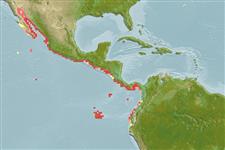
marinhas associadas(os) a recifes; intervalo de profundidade 0 - 50 m (Ref. 55763). Tropical; 35°N - 5°S, 120°W - 76°W
Eastern Pacific: Mexico to Colombia.
Tamanho / Peso / Idade
Maturidade: Lm ? range ? - ? cm
Max length : 92.0 cm TL macho/indeterminado; (Ref. 9313); common length : 50.0 cm TL macho/indeterminado; (Ref. 9313); peso máx. Publicado: 9.6 kg (Ref. 40637)
Descrição breve
Chaves de identificação | Morfologia | Morfometria
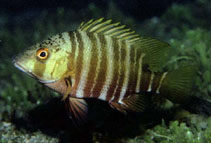
Espinhos dorsais (total) : 10; Raios dorsais moles (total) : 14; Espinhos anais: 3; Raios anais moles: 9. Body deep and compressed; anterior profile of head slightly sloping and somewhat convex; snout prominent; anterior nostril tubular; posterior nostril embedded in a deep furrow; preopercle deeply notched; vomerine and lateral jaw teeth molariform; lower branch of first gill arch with 11 to 15 gill rakers; dorsal scale series running parallel to lateral line; back greenish brown; belly pink; flanks with 8 brownish blue vertical bars (Ref. 55763). Post-opercular notch and knob strong; anterior nostril long and tubular. Scale rows on back running parallel to the lateral line. Color is greenish with a series of about eight bars on sides.
Body shape (shape guide): fusiform / normal; Cross section: oval.
Adults are encountered generally over rocky bottoms in the vicinity of coral reefs, up to at least 40 or 50 m (Ref. 9313). Juveniles may penetrate rocky littoral pools (Ref. 9313). Carnivorous, feed on fishes and invertebrates of the bottom (Ref. 9313). Caught with handlines and marketed fresh (Ref. 9313).
Ciclo de vida e comportamento de acasalamento
Maturidade | Reprodução | Desova | Ovos | Fecundidade | Larvas
Allen, G.R., 1985. FAO Species Catalogue. Vol. 6. Snappers of the world. An annotated and illustrated catalogue of lutjanid species known to date. FAO Fish. Synop. 125(6):208 p. Rome: FAO. (Ref. 55)
Categoria na Lista Vermelha da IUCN (Ref. 130435: Version 2025-2 (Global))
Ameaça para o homem
Harmless
Utilização humana
Pescarias: pescarias de subsistência; peixe desportivo: sim; Aquário: Aquários públicos
Ferramentas
Relatórios especiais
Descarregue XML
Fontes da internet
Estimativas baseadas em modelos
Temperatura preferida (Ref.
123201): 20.6 - 28.5, mean 25.2 °C (based on 54 cells).
Índice de diversidade filogenética (Ref.
82804): PD
50 = 1.0000 [Uniqueness, from 0.5 = low to 2.0 = high].
Bayesian length-weight: a=0.01479 (0.00718 - 0.03045), b=2.96 (2.79 - 3.13), in cm total length, based on LWR estimates for this (Sub)family-body shape (Ref.
93245).
Nível Trófico (Ref.
69278): 3.8 ±0.0 se; based on diet studies.
Resiliência (Ref.
120179): Baixo, tempo mínimo de duplicação da população 4,5 - 14 anos (Preliminary K or Fecundity.).
Vulnerabilidade da pesca (Ref.
59153): High vulnerability (57 of 100).
🛈
Nutrientes (Ref.
124155): Calcium = 23.7 [14.3, 40.5] mg/100g; Iron = 0.445 [0.244, 0.772] mg/100g; Protein = 19.1 [17.3, 20.8] %; Omega3 = 0.123 [0.082, 0.187] g/100g; Selenium = 38.8 [24.0, 66.3] μg/100g; VitaminA = 60.5 [21.2, 184.1] μg/100g; Zinc = 0.896 [0.654, 1.232] mg/100g (wet weight);