>
Cichliformes (Cichlids, convict blennies) >
Cichlidae (Cichlids) > Pseudocrenilabrinae
Eponymy: Dr Percy Rendall (1861–1948) was a medical practitioner and itinerant naturalist who collected over much of Africa and in Trinidad and other Caribbean locations in the late 19th century. [...] (Ref. 128868), visit book page.
More on author: Boulenger.
Окружающая среда: среда / климатическая зона / пределы глубины / диапазон распространения
экология
; пресноводный; солоноватоводный донно-пелагический; немигрирующий (Ref. 126106); пределы глубины 3 - 8 m (Ref. 58302). Tropical; 24°C - 28°C (Ref. 2059); 20°N - 20°S
Africa: from the middle Congo River basin (Kasai drainage and between the Lomami and Kisangani) up to the upper Lualaba and the Bangweulu area (Ref. 55074). Also in Lake Malawi, Zambesi, coastal areas from Zambesi Delta to Natal, Okavango and Cunene (Ref. 5163) as well as the Limpopo, Malagarasi (Ref. 55074) and Lake Tanganyika (Ref. 55074, 74387). Also present in the Cuanza and Catumbela rivers in Angola (Ref. 11970). Introduced in Lake Kivu, escaped from fish ponds (Ref. 107916). Introduced elsewhere usually for weed control and aquaculture. Several countries report adverse ecological impact after introduction.
Длина при первой зрелости / Размер / Вес / Возраст
половая зрелость: Lm 17.7 range ? - ? cm
Max length : 45.0 cm TL самец/пол неопределен; (Ref. 26550); наибольший вес (опубликованные данные): 2.5 kg (Ref. 26550); наибольший возраст (опубликованны данные): 7 годы (Ref. 7248)
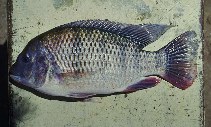
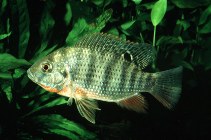
колючие лучи спинного плавника (общее число) : 15 - 17; членистые (мягкие) лучи спинного плавника (общее число) : 10 - 13; колючие лучи анального плавника: 3; членистые (мягкие) лучи анального плавника: 9 - 10; позвонки: 29. Diagnosis: A large, deep-bodied species with a steep head profile, narrow head and small mouth; often appearing brownish with a white belly, some individuals have bright red bellies (Ref. 118638). The sexes look very similar, although males are usually larger (Ref. 118638). Very difficult to distinguish from Coptodon zillii, but C. rendalli usually have a steeper head profile and less prominent vertical bars; in East Africa, the tailfin of C. rendalli is often divided into a brownish upper part and yellowish lower part, whereas that of C. zillii is uniform and spotted (Ref. 118638).
Body shape (shape guide): fusiform / normal; Cross section: compressed.
Adults prefer quiet, well-vegetated water along river littorals or backwaters, floodplains and swamps. They are tolerant of a wide range of temperatures (8-41°C) and salinities (Ref. 3, 7248, 118638). They form schools; is mainly diurnal. Juveniles feed on plankton (Ref. 52307); adults feed on leaves and stems of underwater plants as well as algae, and vegetative detritus (Ref. 52307), insects and crustaceans. A substrate spawner; male and female form pairs to rear the young; eggs and larvae are usually guarded in a steep-side circular pit dug in the mud (Ref. 118638). Occasionally it spawns in large cave-like structures (Ref. 52307), e.g. in Lake Malawi they are reported to dig a network of tunnels at some sites (Ref. 118638). Make excellent eating (Ref. 5214). Widely exploited in fisheries and aquaculture (Ref. 118638).
Prefers a sloping spawning ground near the marginal fringe of vegetation (Ref. 3). Builds nest in shallow water where both parents guard the eggs and young.
Dunz, A.R. and U.K. Schliewen, 2013. Molecular phylogeny and revised classification of the haplotilapiine cichlid fishes formerly referred to as "Tilapia". Mol. Phylogenet. Evol. 68(1):64-80. (Ref. 93285)
Статус Красного Списка МСОП (Ref. 130435: Version 2025-2 (Global))
Угроза для людей
Potential pest
Использование человеком
рыболовство: коммерческий; аквакультура (рыбоводство): коммерческий; объект спортивного рыболовства: да; аквариум: коммерческий
дополнительная информация
инструменты
Специальные отчеты
Скачать в формате XML
ресурсы в Интернет
Оценки, основанные на моделях
Индекс филогенетического разнообразия (ссылка
82804): PD
50 = 0.5000 [Uniqueness, from 0.5 = low to 2.0 = high].
Bayesian length-weight: a=0.01585 (0.01347 - 0.01864), b=3.00 (2.96 - 3.04), in cm total length, based on LWR estimates for this species (Ref.
93245).
Трофический уровень (ссылка
69278): 2.3 ±0.1 se; based on diet studies.
Generation time: 3.4 (2.1 - 6.2) years. Estimated as median ln(3)/K based on 18
growth studies.
устойчивость к внешним воздействиям (ссылка
120179): средний (среднего размера), минимальное время удвоения популяции 1.4-4.4 года (K=0.13-0.18; tmax=7).
Уязвимость рыбной ловли (Ref.
59153): Low to moderate vulnerability (27 of 100).
🛈