>
Cichliformes (Cichlids, convict blennies) >
Cichlidae (Cichlids) > Pseudocrenilabrinae
Etymology: Oreochromis: Latin, aurum = gold + Greek, chromis = a fish, perhaps a perch (Ref. 45335); andersonii: Named for the Swede Charles John Anderson, who explored Namibia during the middle of the 19th century (Ref. 13337).
Eponymy: Charles John Andersson (1827–1867) aka Karl Johan Andersson explored Southwest Africa (Namibia) in the 19th century. [...] (Ref. 128868), visit book page.
More on author: Castelnau.
Môi trường: môi trường / vùng khí hậu / Mức độ sâu / phạm vi phân phối
Sinh thái học
; nước ngọt; thuộc về nước lợ sống nổi và đáy; mức độ sâu 0 - 10 m (Ref. 54002), usually 3 - 6 m (Ref. 54002). Tropical; 18°C - 33°C (Ref. 3); 12°S - 21°S
Africa: Ngami basin, Okavango River; Cunene River and Mossamedes, Angola; upper Zambezi, Kafue River; middle Zambezi, Lake Kariba and Cabora Bassa since construction of dams. Several countries report adverse ecological impact after introduction (2265). Also reported from the Kasai system in Angola (Ref. 120641). Reported as introduced in Kasanka National Park (upper Congo River basin) in Zambia (Ref. 95585).
Chiều dài lúc trưởng thành đầu tiên / Bộ gần gũi / Khối lượng (Trọng lượng) / Tuổi
Chín muồi sinh dục: Lm 20.7, range 12 - 15 cm
Max length : 61.0 cm TL con đực/không giới tính; (Ref. 40637); Khối lượng cực đại được công bố: 4.7 kg (Ref. 40637); Tuổi cực đại được báo cáo: 13 các năm (Ref. 13400)
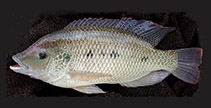
Các tia vây lưng cứng (tổng cộng) : 15 - 18; Các vây lưng mềm (tổng cộng) : 11 - 15; Tia cứng vây hậu môn: 3; Tia mềm vây hậu môn: 9 - 13; Động vật có xương sống: 30 - 32. Diagnosis: male genital papilla bluntly conical with a narrow flange slightly notched in the middle; jaws enlarged in breeding males, which in this species are normally not less than 30cm TL; scales in lateral line series 31-35, usually 32-33; scales of cheek in 3 full rows; vertebrae 30-32; total number of dorsal rays 28-31. Pectoral fin in adults 34-43% SL (Ref. 2), very long (Ref. 1904). Depth of body 40.5-50.5% SL; color-pattern of non-breeding fish and female always including 3 or 4 conspicuous mid-lateral blotches and a red margin on dorsal and caudal fins; breeding male with red margins broader and brighter and general dark, iridescent purplish-brown color of head, back and flanks, masking the blotches; no series of vertical spots or vertical stripes on caudal fin; nest a simple circular depression (Ref. 2).
Body shape (shape guide): fusiform / normal; Cross section: compressed.
Occurs in both river and swamp habitats and is adapted to fairly fast-flowing rivers (Ref. 6465). Hardy, tolerating fresh and brackish water (up to 20ppt, Ref. 3), preferring slow-flowing or standing water; adults occupy deep open waters, juveniles remain inshore among vegetation (Ref. 7248, 52193). Prefers fairly deep, quiet water with some weed cover; hippo pools are a favoured retreat (Ref. 12524, 13337). Forms schools (Ref. 2, 12524, 13337). Mainly diurnal; a detritivore which feeds on fine particulate matter (Ref. 2), including algae (Ref. 246, 12524, 13337, 53992), diatoms, detritus (Ref. 7248, 52193, 53992) and zooplankton (Ref. 7248, 52193). Larger individuals also take insects and other invertebrates (Ref. 53992). Feeding regime is variable, the diet changes according to food availability (Ref. 6465). Female mouthbrooder (Ref. 87, 246, 6465, 12524, 13337). Fine angling and table species (Ref. 6465, 12524, 13337).
Spawning did not occur in ponds at a temperature below 21°C (Ref. 2). Rarely more than one brood in a season (Ref. 87, 246), but known to breed at least twice a year under pond conditions (Ref. 12524, 13337). Males excavate saucer-shaped nests (Ref. 246, 314, 6465, 12524, 13337, 54048) that can be up to 75cm in diameter and 30cm deep, using mouth and fins (Ref. 2, 314, 52307), in the center of their territory (Ref. 52307), on a sandy substrate (any vegetation is uprooted with its mouth) and in water from 1-3m deep, where they display to attract females (Ref. 12524, 13337, 54048). Up to 40 nests can be found together (Ref. 6465). Females are the primary care-givers (Ref. 52307), moutbrooding eggs, larvae and fry; multiple broods are raised during the warmer months (Ref. 7248, 52193). She lays her eggs in the concavity on top of the nest, the male fertilizes the eggs whereupon the female takes the eggs into her mouth where they are incubated; males guard the nest and females against all intruders; parental care is exercised for the first few weeks after the eggs hatch (Ref. 12524, 13337).
Trewavas, E., 1983. Tilapiine fishes of the genera Sarotherodon, Oreochromis and Danakilia. British Mus. Nat. Hist., London, UK. 583 p. (Ref. 2)
Tình trạng Sách đỏ IUCN (Ref. 130435: Version 2025-2 (Global))
Mối đe dọa đối với con người
Potential pest (Ref. 6465)
Sử dụng của con người
Các nghề cá: tính thương mại; Nuôi trồng thủy sản: tính thương mại; cá để chơi: đúng
Các công cụ
Báo cáo đặc biệt
Tải xuống XML
Các nguồn internet
Ước tính dựa trên mô hình
Chỉ số đa dạng phát sinh loài (Tài liệu tham khảo
82804): PD
50 = 0.5000 [Uniqueness, from 0.5 = low to 2.0 = high].
Bayesian length-weight: a=0.01549 (0.01202 - 0.01996), b=3.00 (2.96 - 3.04), in cm total length, based on LWR estimates for this species (Ref.
93245).
Mức dinh dưỡng (Tài liệu tham khảo
69278): 2.1 ±0.0 se; based on diet studies.
Thích nghi nhanh (Tài liệu tham khảo
120179): Trung bình, thời gian nhân đôi của chủng quần tối thiểu là 1.4 - 4.4 năm (K=0.17-0.22; tm=4; tmax=13).
Sự dễ bị tổn thương của nghề đánh cá (Ref.
59153): Moderate vulnerability (40 of 100).
🛈