Ambiente: milieu / zona climatica / distribuzione batimetrica / gamma di distribuzione
Ecologia
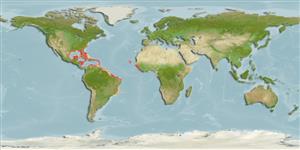
marino demersale; distribuzione batimetrica 1 - 120 m (Ref. 36484), usually ? - 15 m (Ref. 3589). Tropical; 40°N - 24°S, 99°W - 9°E (Ref. 5222)
Western Atlantic: Massachusetts, USA and Bermuda to the Gulf of Mexico, the Caribbean and southern Brazil. Eastern Atlantic: Ascension and St. Helena islands; dubious records from the Canary Islands, Cape Verde and South Africa (Ref. 1496, 1953, 6572) are discussed by Heemstra (Ref. 6512). Also recorded from eastern Atlantic from Sao Tome in the Gulf of Guinea and from the Azores (Portugal) (Ref. 089707).
Lunghezza alla prima maturità / Dimensione / Peso / Età
Maturità: Lm 30.4, range 25 - 36 cm
Max length : 65.0 cm TL maschio/sesso non determinato; (Ref. 118680); common length : 35.0 cm TL maschio/sesso non determinato; (Ref. 5217); peso massimo pubblicato: 4.5 kg (Ref. 118249); Età massima riportata: 25 anni (Ref. 118249)
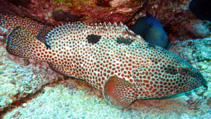
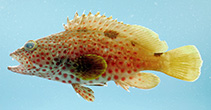
Spine dorsali (totale) : 11; Raggi dorsali molli (totale) : 16 - 17; Spine anali: 3; Raggi anali molli: 8. Maxilla without scales. Preopercle with rounded, only slightly enlarged, spines at its angle. Opercle with 3 flat spines, middle one the largest. Pelvic fins shorter than pectorals and shorter than longest dorsal spine. Bases of soft dorsal and anal fins covered with scales and thick skin. 2 or 3 dark saddles along base of dorsal fin and another on top of caudal peduncle. Tan with red spots on head, body and fins, spots becoming larger ventrally (Ref. 26938); characterized further by: body depth less than head length, 2.6-3.2 times in SL; head length 2.1-2.5 in SL; interorbital area flat or slightly concave; preopercle evenly serrate; smooth subopercle and interopercle; subequal posterior and anterior nostrils (Ref. 089707).
Body shape (shape guide): fusiform / normal.
Inhabits rocky reefs. Usually solitary (Ref. 29). Difficult to approach (Ref. 9710). Juveniles often seen in rockpools (Ref. 86997). Feeds mainly on crabs (67%) and fishes (20%). In the Ascension I., feeds on juvenile Melichthys niger and young sea turtles. Its flesh is of good quality. Marketed fresh. Angling: Like other grouper, rock hind are caught by fishing at the right depth over an irregular bottom (Ref. 84357).
Ciclo vitale e comportamento di accoppiamento
Maturità | Riproduzione | Deposizione | Uova | Fecondità | Larve
Heemstra, P.C. and J.E. Randall, 1993. FAO Species Catalogue. Vol. 16. Groupers of the world (family Serranidae, subfamily Epinephelinae). An annotated and illustrated catalogue of the grouper, rockcod, hind, coral grouper and lyretail species known to date. Rome: FAO. FAO Fish. Synop. 125(16):382 p. (Ref. 5222)
Stato della Lista Rossa IUCN (Ref. 130435: Version 2025-2 (Global))
Minaccia per l'uomo
Reports of ciguatera poisoning (Ref. 31172)
Usi umani
Pesca: elevato interesse commerciale; Pesce da pesca sportiva: si
Strumenti
Rapporti speciali
Scarica XML
Fonti Internet
Stime basate su modelli
Temperatura preferita (Fonte Biblio.
123201): 24.2 - 28.1, mean 27.3 °C (based on 1043 cells).
Indice di diversità filogenetica (Fonte Biblio.
82804): PD
50 = 0.5000 [Uniqueness, from 0.5 = low to 2.0 = high].
Bayesian length-weight: a=0.01175 (0.00735 - 0.01879), b=3.10 (2.97 - 3.23), in cm total length, based on LWR estimates for this species & Genus-body shape (Ref.
93245).
Livello trofico (Fonte Biblio.
69278): 3.5 ±0.4 se; based on diet studies.
Resilienza (Fonte Biblio.
120179): Basso, tempo minimo di raddoppiamento della popolazione 4.5 - 14 anni (K=0.11).
Vulnerabilità della pesca (Ref.
59153): High vulnerability (63 of 100).
🛈
Nutrienti (Ref.
124155): Calcium = 86.2 [37.2, 188.8] mg/100g; Iron = 0.991 [0.462, 2.360] mg/100g; Protein = 17.7 [16.1, 19.2] %; Omega3 = 0.203 [0.104, 0.371] g/100g; Selenium = 71.6 [34.9, 165.7] μg/100g; VitaminA = 32.5 [8.0, 126.3] μg/100g; Zinc = 1.24 [0.78, 2.01] mg/100g (wet weight);