>
Eupercaria/misc (Various families in series Eupercaria) >
Lutjanidae (Snappers) > Lutjaninae
Etymology: Lutjanus: Malay, ikan lutjan, name of a fish.
More on author: Günther.
Environnement : milieu / zone climatique / profondeur / gamme de distribution
Écologie
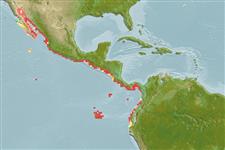
marin récifal; profondeur 0 - 60 m (Ref. 55763). Tropical; 33°N - 5°S, 117°W - 77°W (Ref. 55)
Eastern Pacific: Mexico to Ecuador.
Taille / Poids / Âge
Maturité: Lm ? range ? - ? cm
Max length : 100.0 cm TL mâle / non sexé; (Ref. 55763); common length : 35.0 cm TL mâle / non sexé; (Ref. 55763); poids max. publié: 15.0 kg (Ref. 40637)
Description synthétique
Clés d'identification | Morphologie | Morphométrie
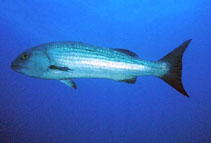
Épines dorsales (Total) : 11 - 12; Rayons mous dorsaux (Total) : 12; Épines anales: 3; Rayons mous anaux: 7 - 8. Preopercular notch and knob moderate. Scale rows on back parallel to lateral line. Dark gray-green on back, lighter on belly. Scales with yellowish white centers, forming alternating dark and light stripes on the sides. Individuals from deeper waters are mainly reddish.
Body shape (shape guide): fusiform / normal; Cross section: oval.
This is an inshore, reef-dwelling species found over hard bottoms until at least 50 m depth (Ref. 9313). Adults may form schools consisting of several hundreds of individuals (Ref. 9313). Juveniles are encountered in shallow waters, including littoral pools and estuaries (Ref. 9313). Carnivorous, feed on fish and invertebrates (Ref. 9313). Marketed fresh.
Cycle de vie et comportement reproducteur
Maturité | Reproduction | Frai | Œufs | Fécondité | Larves
Allen, G.R., 1985. FAO Species Catalogue. Vol. 6. Snappers of the world. An annotated and illustrated catalogue of lutjanid species known to date. FAO Fish. Synop. 125(6):208 p. Rome: FAO. (Ref. 55)
Statut dans la liste rouge de l'IUCN (Ref. 130435: Version 2025-2 (Global))
Menace pour l'homme
Harmless
Utilisations par l'homme
Pêcheries: pêcheries vivrières; pêche sportive: oui
Outils
Articles particuliers
Télécharger en XML
Sources Internet
Estimations basées sur des modèles
Température préférée (Réf.
123201): 20.6 - 28.7, mean 25.9 °C (based on 76 cells).
Indice de diversité phylogénétique (Réf.
82804): PD
50 = 0.5000 [Uniqueness, from 0.5 = low to 2.0 = high].
Bayesian length-weight: a=0.01479 (0.00706 - 0.03101), b=2.96 (2.80 - 3.12), in cm total length, based on LWR estimates for this Genus-body shape (Ref.
93245).
Niveau trophique (Réf.
69278): 4.1 ±0.65 se; based on food items.
Résilience (Réf.
120179): Faible, temps minimum de doublement de population : 4,5 à 14 années (Preliminary K or Fecundity.).
Vulnérabilité de la pêche (Ref.
59153): High vulnerability (60 of 100).
🛈
Nutriments (Ref.
124155): Calcium = 20.7 [13.2, 30.8] mg/100g; Iron = 0.272 [0.173, 0.414] mg/100g; Protein = 18.7 [17.2, 20.0] %; Omega3 = 0.117 [0.082, 0.161] g/100g; Selenium = 71 [47, 106] μg/100g; VitaminA = 106 [20, 381] μg/100g; Zinc = 0.364 [0.295, 0.495] mg/100g (wet weight);