>
Eupercaria/misc (Various families in series Eupercaria) >
Lutjanidae (Snappers) > Lutjaninae
Etymology: Lutjanus: Malay, ikan lutjan, name of a fish.
More on author: Bloch.
Ambiente: milieu / zona climatica / distribuzione batimetrica / gamma di distribuzione
Ecologia
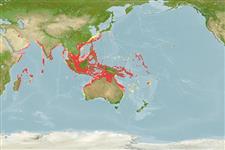
marino associati a barriera corallina; distribuzione batimetrica 5 - 100 m (Ref. 55). Tropical; 34°N - 35°S, 47°E - 180°E (Ref. 55)
Indo-West Pacific: Persian Gulf and Gulf of Oman to Fiji, north to southern Japan and Jeju Island, Korea (Ref. 114833), south to New South Wales, Australia (Ref. 114833) and New Caledonia (Ref. 86942). This species has been referred to as Lutjanus malabaricus (non Schneider) or Lutjanus altifrontalis by many recent authors. Occurrence in the Red Sea is a misidentification (Ref. 84159).
Lunghezza alla prima maturità / Dimensione / Peso / Età
Maturità: Lm 50.2, range 50 - ? cm
Max length : 81.6 cm FL maschio/sesso non determinato; (Ref. 5739); common length : 45.0 cm TL maschio/sesso non determinato; (Ref. 55); Età massima riportata: 8 anni (Ref. 5739)
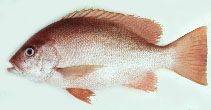
Spine dorsali (totale) : 11; Raggi dorsali molli (totale) : 12 - 14; Spine anali: 3; Raggi anali molli: 8 - 9. Deep-bodied. Dorsal profile of head sloped. Length of upper jaw smaller than distance bet. base of last dorsal and anal rays. Preorbital bone usually narrower than eye diameter. Preopercular notch and knob poorly developed. Scale rows on back rising obliquely above lateral line. Juveniles with an oblique band extending from mouth to beginning of dorsal fin and a black spot at the caudal peduncle (Ref. 469). Body depth 2.5-3.0 in SL (Ref. 90102).
Body shape (shape guide): fusiform / normal; Cross section: oval.
Adults inhabit trawling grounds and reefs. They are present over shoals, rubble, corals, large epibenthos, hard or sandy mud substrates and offshore reefs (Ref. 6390). Usually in groups (Ref. 90102). Juveniles from about 2.5 cm length inhabit shallow waters over muddy substrates (Ref. 6390). Feed on a broad range of prey dominated by fish, and with small amounts of crustaceans, cephalopods and other benthic invertebrates (Ref. 6390). They forage mostly at night (Ref. 6390). They are marketed either gilled and gutted, whole as fillets, as fresh chilled or frozen product (Ref. 6390).
Are serial batch spawners (Ref. 6390).
Allen, G.R., 1985. FAO Species Catalogue. Vol. 6. Snappers of the world. An annotated and illustrated catalogue of lutjanid species known to date. FAO Fish. Synop. 125(6):208 p. Rome: FAO. (Ref. 55)
Stato della Lista Rossa IUCN (Ref. 130435: Version 2025-2 (Global))
Minaccia per l'uomo
Harmless
Usi umani
Pesca: commerciale; Acquacoltura: commerciale
Strumenti
Rapporti speciali
Scarica XML
Fonti Internet
Stime basate su modelli
Temperatura preferita (Fonte Biblio.
123201): 25.3 - 29.1, mean 28.2 °C (based on 1590 cells).
Indice di diversità filogenetica (Fonte Biblio.
82804): PD
50 = 0.5000 [Uniqueness, from 0.5 = low to 2.0 = high].
Bayesian length-weight: a=0.01585 (0.00947 - 0.02651), b=2.95 (2.82 - 3.08), in cm total length, based on LWR estimates for this species & Genus-body shape (Ref.
93245).
Livello trofico (Fonte Biblio.
69278): 4.5 ±0.7 se; based on diet studies.
Resilienza (Fonte Biblio.
120179): Basso, tempo minimo di raddoppiamento della popolazione 4.5 - 14 anni (K=0.08-0.41; tm=4; tmax=8; Fec=5 million).
Prior r = 0.66, 95% CL = 0.43 - 0.99, Based on 1 data-limited stock assessment.
Vulnerabilità della pesca (Ref.
59153): Moderate vulnerability (42 of 100).
🛈
Nutrienti (Ref.
124155): Calcium = 25.7 [15.5, 39.1] mg/100g; Iron = 0.342 [0.214, 0.558] mg/100g; Protein = 18.7 [17.2, 20.1] %; Omega3 = 0.136 [0.091, 0.202] g/100g; Selenium = 73.1 [45.4, 124.1] μg/100g; VitaminA = 154 [31, 621] μg/100g; Zinc = 0.308 [0.236, 0.442] mg/100g (wet weight);