>
Eupercaria/misc (Various families in series Eupercaria) >
Sciaenidae (Drums or croakers)
Eponymy: “Lanfear B. Norrie of New York City” was honoured in the binomial with no further information or explanation being given. However, we believe this to be the mining engineer and minerals prospector Lanfear Barbey Norrie (1896–1977) whoowned mining [...] (Ref. 128868), visit book page.
Environnement : milieu / zone climatique / profondeur / gamme de distribution
Écologie
marin démersal; profondeur ? - 60 m (Ref. 9118). Tropical; 2°S -
Southeast Pacific: Ecuador to Peru.
Taille / Poids / Âge
Maturité: Lm ? range ? - ? cm
Max length : 40.0 cm TL mâle / non sexé; (Ref. 9118); common length : 25.0 cm TL mâle / non sexé; (Ref. 9118)
Description synthétique
Clés d'identification | Morphologie | Morphométrie
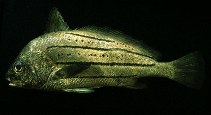
Body elongate, moderately compressed, and deep, with a strongly arched dorsal profile; snout prominent; mouth small and inferior; lower jaw enclosed by upper; chin with 5 pores but without barbels; edge of preopercle slightly serrate; lower branch of first gill arch with 4 to 5 gill rakers; second dorsal fin very long, with 35 to 38 soft rays; body uniformly brown to dark gray; flanks with 4 very distinct longitudinal stripes; pelvic fins dark; other fins dark edged (Ref. 55763).
Body shape (shape guide): fusiform / normal; Cross section: other (see Diagnosi.
Inhabits rocky areas (Ref. 9118). Feeds on the epifauna of the substrate (Ref. 9118). Occasionally in local markets (Ref. 9118).
Cycle de vie et comportement reproducteur
Maturité | Reproduction | Frai | Œufs | Fécondité | Larves
Chao, L.N., 1995. Sciaenidae. Corvinas, barbiches, bombaches, corvinatas, corvinetas, corvinillas, lambes, pescadillas, roncachos, verrugatos. p. 1427-1518. In W. Fischer, F. Krupp, W. Schneider, C. Sommer, K.E. Carpenter and V. Niem (eds.) Guia FAO para identificacion de especies para los fines de la pesca. Pacifico Centro-oriental. 3 volumes. 1813 p. (Ref. 9118)
Statut dans la liste rouge de l'IUCN (Ref. 130435: Version 2025-2 (Global))
Menace pour l'homme
Harmless
Utilisations par l'homme
Pêcheries: intérêt commercial mineur
Outils
Articles particuliers
Télécharger en XML
Sources Internet
Estimations basées sur des modèles
Indice de diversité phylogénétique (Réf.
82804): PD
50 = 0.5039 [Uniqueness, from 0.5 = low to 2.0 = high].
Bayesian length-weight: a=0.00871 (0.00427 - 0.01777), b=3.08 (2.91 - 3.25), in cm total length, based on LWR estimates for this (Sub)family-body shape (Ref.
93245).
Niveau trophique (Réf.
69278): 3.5 ±0.37 se; based on food items.
Résilience (Réf.
120179): Milieu, temps minimum de doublement de population : 1,4 à 4,4 années (Preliminary K or Fecundity.).
Vulnérabilité de la pêche (Ref.
59153): Low to moderate vulnerability (30 of 100).
🛈