>
Eupercaria/misc (Various families in series Eupercaria) >
Lutjanidae (Snappers) > Lutjaninae
Etymology: Lutjanus: Malay, ikan lutjan, name of a fish.
More on author: Bloch.
Environnement : milieu / zone climatique / profondeur / gamme de distribution
Écologie
marin récifal; profondeur 10 - 30 m (Ref. 9710). Tropical
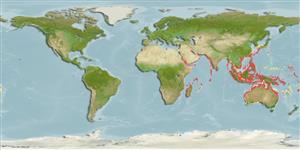
Indo-West Pacific: widespread; from South Africa to the Philippines; north to Japan. Records from the Middle East, including the Red Sea, refer to L. sapphirolineatus.
Taille / Poids / Âge
Maturité: Lm ? range ? - ? cm
Max length : 30.0 cm TL mâle / non sexé; (Ref. 55); common length : 20.0 cm TL mâle / non sexé; (Ref. 55)
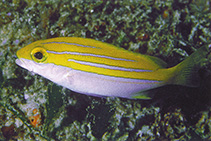
Épines dorsales (Total) : 11; Rayons mous dorsaux (Total) : 13 - 14; Épines anales: 3; Rayons mous anaux: 8. This species is distinguished by the following characters: D XI,13 or 14 (usually 13); A III, 8; pectoral-fin 16 or 17; lateral-line scales 47-50; horizontal scale rows above the lateral line 8 or 9; scale rows above lateral line rising obliquely toward dorsal profile; predorsal scales extending forward nearly to level of just above anterior edge of orbit; scale rows on cheek 8-11; without subocular extension of cheek scales; gill rakers on first arch 7 or 8 + 15-17 = 22-25; tongue is smooth, toothless; preopercular notch developed just above angle; interopercular knob inconspicuous; the first blue stripe is running from above anterior edge of eye and ending below the 7?9th dorsal-fin spine base; third stripe usually running from middle of upper part of opercle or anterior edge of upper opercle to below posterior fourth of soft portion of dorsal fin, reaching the last soft dorsal-ray base (Ref. 110188).
Body shape (shape guide): fusiform / normal; Cross section: compressed.
Adults mainly inhabit coral and rocky reefs (Ref. 30573). They sometimes form small aggregations around rocky outcrops and coral heads during daylight hours. Feed on fishes and crustaceans (Ref. 30573).
Cycle de vie et comportement reproducteur
Maturité | Reproduction | Frai | Œufs | Fécondité | Larves
Iwatsuki, Y., J.M. Al-Mamry and P.C. Heemstra, 2016. Validity of a blue stripe snapper, Lutjanus octolineatus (Cuvier 1828) and a related species, L. bengalensis (Bloch 1790) with a new species (Pisces; Lutjanidae) from the Arabian Sea. Zootaxa 4098(3):511-528. (Ref. 110188)
Statut dans la liste rouge de l'IUCN (Ref. 130435: Version 2025-2 (Global))
Menace pour l'homme
Harmless
Utilisations par l'homme
Pêcheries: commercial
Outils
Articles particuliers
Télécharger en XML
Sources Internet
Estimations basées sur des modèles
Température préférée (Réf.
123201): 26.7 - 29.3, mean 28.6 °C (based on 460 cells).
Indice de diversité phylogénétique (Réf.
82804): PD
50 = 0.5000 [Uniqueness, from 0.5 = low to 2.0 = high].
Bayesian length-weight: a=0.01479 (0.00706 - 0.03101), b=2.96 (2.80 - 3.12), in cm total length, based on LWR estimates for this Genus-body shape (Ref.
93245).
Niveau trophique (Réf.
69278): 3.9 ±0.63 se; based on food items.
Résilience (Réf.
120179): Milieu, temps minimum de doublement de population : 1,4 à 4,4 années (Preliminary K or Fecundity.).
Vulnérabilité de la pêche (Ref.
59153): Low vulnerability (20 of 100).
🛈
Nutriments (Ref.
124155): Calcium = 49.3 [32.8, 71.2] mg/100g; Iron = 0.385 [0.243, 0.594] mg/100g; Protein = 18.5 [17.0, 19.8] %; Omega3 = 0.133 [0.092, 0.189] g/100g; Selenium = 47.9 [31.5, 71.7] μg/100g; VitaminA = 168 [30, 630] μg/100g; Zinc = 0.523 [0.410, 0.729] mg/100g (wet weight);