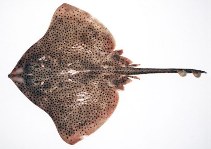
Elasmobranchii (Haie und Rochen) (sharks and rays) >
Rajiformes (Skates and rays) >
Arhynchobatidae (Softnose skates)
Etymology: Atlantoraja: Greek, atlantes = having the strength of Atlas, the god that supported the pillars of the universe in the Greek mithology + Latin, raja = ray (Raja sp.) (Ref. 45335).
Eponymy: Francis(co) Louis Nompar de Caumont, Comte de Laporte de Castelnau (1810–1880) was a career diplomat and naturalist who was born in London, studied natural science in Paris, and then led a French scientific expedition to study the lakes of Canada, [...] (Ref. 128868), visit book page.
Umwelt: Milieu / Klimazone / Tiefenbereich / Verbreitungsgebiet
Ökologie
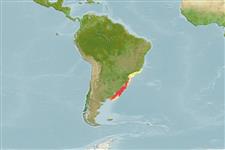
seewasser demersal; tiefenbereich 10 - 100 m (Ref. 57911). Subtropical; 20°S - 40°S, 60°W - 40°W (Ref. 57911)
Southwest Atlantic: Brazil, Uruguay and Argentina.
Länge bei der ersten Reifung / Größe / Gewicht / Alter
Geschlechtsreife: Lm 105.0 range ? - ? cm
Max length : 132 cm TL Männchen/unbestimmt; (Ref. 57911); common length : 45.0 cm TL Männchen/unbestimmt; (Ref. 6077)
Oviparous. Distinct pairing with embrace. Young may tend to follow large objects, such as their mother (Ref. 205). Eggs are oblong capsules with stiff pointed horns at the corners deposited in sandy or muddy flats (Ref. 205). Egg capsule measures 92-103 mm long and 72-80 mm wide (Ref. 41249). Utilized as fishmeal (Ref. 6077).
Lebenszyklus und Paarungsverhalten
Geschlechtsreife | Fortpflanzung | Ablaichen | Eier | Fruchtbarkeit | Larven
Oviparous, paired eggs are laid. Embryos feed solely on yolk (Ref. 50449). Distinct pairing with embrace. Young may tend to follow large objects, such as their mother (Ref. 205).
McEachran, J.D. and K.A. Dunn, 1998. Phylogenetic analysis of skates, a morphologically conservative clade of elasmobranchs (Chondrichthyes: Rajidae). Copeia 1998(2):271-290. (Ref. 27314)
IUCN Rote Liste Status (Ref. 130435: Version 2025-2 (Global))
Bedrohung für Menschen
Harmless
Nutzung durch Menschen
Fischereien: nicht kommerziell
Tools
Zusatzinformationen
Download XML
Internet Quellen
Schätzungen auf der Grundlage von Modellen
Bevorzugte Temperatur (Ref.
123201): 10.6 - 23.2, mean 17.1 °C (based on 116 cells).
Phylogenetischer Diversitätsindex (Ref.
82804): PD
50 = 0.6250 [Uniqueness, from 0.5 = low to 2.0 = high].
Bayesian length-weight: a=0.00550 (0.00279 - 0.01081), b=3.11 (2.94 - 3.28), in cm total length, based on LWR estimates for this (Sub)family-body shape (Ref.
93245).
Trophische Ebene (Ref.
69278): 4.5 ±0.80 se; based on food items.
Widerstandsfähigkeit (Ref.
120179): niedrig, Verdopplung der Population dauert 4,5 - 14 Jahre. (Fec assumed to be <100).
Anfälligkeit der Fischerei (Ref.
59153): Very high vulnerability (79 of 100).
🛈