>
Cichliformes (Cichlids, convict blennies) >
Cichlidae (Cichlids) > Pseudocrenilabrinae
Etymology: Oreochromis: Latin, aurum = gold + Greek, chromis = a fish, perhaps a perch (Ref. 45335); mortimeri: Named for M.A.E. Mortimer, a fish culturist who conducted a great deal of productive fish culture research in Zambia between 1951 and 1965 (Ref. 13337).
Eponymy: M A E Mortimer was a Research and Administrative Officer of the Zambian Department of Game and Fisheries. [...] (Ref. 128868), visit book page.
More on author: Trewavas.
Ambiente: milieu / zona climatica / distribuzione batimetrica / gamma di distribuzione
Ecologia
; acqua dolce benthopelagico. Tropical; 10°S - 19°S
Africa: Middle Zambezi and its tributaries, including Luangwa River (except probably the upper reaches of its tributaries Lunsemfwa and Mulungwishi above the escarpment), Hunyani River and Lake Kariba (Ref. 5166). Introduced to Kipopo and the Lufira River (upper Congo River basin) in Democratic Republic of the Congo (Ref. 1978).
Lunghezza alla prima maturità / Dimensione / Peso / Età
Maturità: Lm 22.0 range ? - ? cm
Max length : 48.0 cm TL maschio/sesso non determinato; (Ref. 5309); peso massimo pubblicato: 4.1 kg (Ref. 13337); Età massima riportata: 8 anni (Ref. 2)
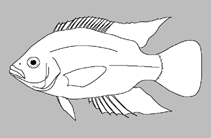
Spine dorsali (totale) : 16 - 17; Raggi dorsali molli (totale) : 10 - 13; Spine anali: 3; Raggi anali molli: 10 - 12; Vertebre: 29 - 30. Diagnosis: jaws greatly enlarged in mature males; scales in 2-3 rows on cheek; caudal peduncle relatively shorter than in O. mossambicus (Ref. 2). In life greenish grey (Ref. 2), green-blue (Ref. 52307) or grey-blue with a darker spot on each scale (Ref. 2, 52307). Females and immature males often with 1-3 dark mid-lateral blotches (Ref. 2, 52307), which may appear only as the fish dies (Ref. 2). Breeding males: predominantly iridescent blue-green to bronze (Ref. 2, 52307), with iridescent spots on dorsal and caudal fins (Ref. 2), a dorsal fin with a red edge that is not as pronounced as in O. mossambicus, and a narrow (as opposed to wide) red band at posterior end of caudal fin (Ref. 12524, 13337).
Body shape (shape guide): short and / or deep; Cross section: compressed.
Forms schools (Ref. 2, 54048). Is mainly diurnal; salt-tolerant (Ref. 2). Feeds mainly on (filamentous) algae (Ref. 2, 12524, 13337, 52307, 54048) and diatoms, as well as higher plants (Ref. 2, 52307), dipterous larvae, cladocerans, copepods (Ref. 2), aquatic and terrestrial insects, shrimps, worms (Ref. 12524, 13337, 54048) and mollusks (Ref. 54048). Mouthbrooder; spawns several times per year (Ref. 12524, 13337, 54048).
Ciclo vitale e comportamento di accoppiamento
Maturità | Riproduzione | Deposizione | Uova | Fecondità | Larve
Nest a saucer-shaped depression with a raised mound in the middle (Ref. 12524, 13337), made by the male in a breeding arena in shallow water down to about 4m (Ref. 54048). Females are lured to these through male courtship displays; female collects eggs in mouth after spawning and fertilisation, and moves off; mouthbrooding females may shoal together and do not feed at this time; eggs hatch after about ten days but remain in the mouth for a further few days; juveniles make short feeding sorties once the storage yolk is used up, but seldom stray far and dart into her mouth when danger threatens; after about another 10 days young are released in warm shallow water in the margins (nursery areas), where they feed independently in small shoals (Ref. 54048). Young released from mouthbrooding female are about 1cm long (Ref. 2). Female returns to the breeding arena where she spawns again (Ref. 54048).
Trewavas, E., 1983. Tilapiine fishes of the genera Sarotherodon, Oreochromis and Danakilia. British Mus. Nat. Hist., London, UK. 583 p. (Ref. 2)
Stato della Lista Rossa IUCN (Ref. 130435: Version 2025-2 (Global))
Minaccia per l'uomo
Harmless
Usi umani
Pesca: commerciale; Acquacoltura: sperimentale; Pesce da pesca sportiva: si
Strumenti
Rapporti speciali
Scarica XML
Fonti Internet
Stime basate su modelli
Indice di diversità filogenetica (Fonte Biblio.
82804): PD
50 = 0.5000 [Uniqueness, from 0.5 = low to 2.0 = high].
Bayesian length-weight: a=0.01995 (0.00952 - 0.04183), b=3.02 (2.84 - 3.20), in cm total length, based on LWR estimates for this species & (Sub)family-body (Ref.
93245).
Livello trofico (Fonte Biblio.
69278): 2.2 ±0.0 se; based on diet studies.
Generation time: 4.3 ( na - na) years. Estimated as median ln(3)/K based on 1
growth studies.
Resilienza (Fonte Biblio.
120179): Medio, tempo minimo di raddoppiamento della popolazione 1.4 - 4.4 anni (tmax=8).
Vulnerabilità della pesca (Ref.
59153): Moderate vulnerability (39 of 100).
🛈