>
Siluriformes (Catfishes) >
Pangasiidae (Shark catfishes)
Etymology: Pangasianodon: The Vietnamese name of a fish + Greek, odous = teeth (Ref. 45335).
More on author: Sauvage.
Milieu: milieu / Klimaatzone / Diepte / verspreidingsgebied
Ecologie
; zoet water benthopelagisch; pH range: 6.5 - 7.5; dH range: 2 - 29; potamodroom (Ref. 138296). Tropical; 22°C - 26°C (Ref. 13371); 19°N - 8°N
Asia: Mekong, Chao Phraya, and Maeklong basins. Introduced into additional river basins for aquaculture.
Grootte / Gewicht / Leeftijd
Maturiteit: Lm ? range ? - ? cm
Max length : 130 cm SL mannelijk / geslacht onbekend; (Ref. 7432); max. gepubliceerd gewicht: 44.0 kg (Ref. )
Korte beschrijving
Determinatiesleutels | Morfologie | Morfometrie
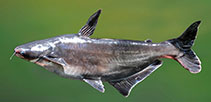
Fins dark grey or black; 6 branched dorsal-fin rays; gill rakers normally developed; young with a black stripe along lateral line and a second long black stripe below lateral line, large adults uniformly grey (Ref. 12693). Dark stripe on the middle of anal fin; dark stripe in each caudal lobe; small gill rakers regularly interspersed with larger ones (Ref. 43281).
Body shape (shape guide): elongated.
Facultative air-breathing (Ref. 126274); Adults inhabit large rivers (Ref. 12693). Recorded as having been or being farmed in rice fields (Ref. 119549). Omnivorous (Ref. 6459), feeding on fish and crustaceans as well as on vegetable debris (Ref. 12693). A migratory species, moving upstream of the Mekong from unknown rearing areas to spawn in unknown areas in May-July and returning to the mainstream when the river waters fall seeking rearing habitats in September -December (Ref. 37772). South of the Khone Falls, upstream migration occurs from October to February, with peak in November-December. This migration is triggered by receding water and appears to be a dispersal migration following the lateral migration from flooded areas back into the Mekong at the end of the flood season. Downstream migration takes place from May to August from Stung Treng to Kandal in Cambodia and further into the Mekong Delta in Viet Nam. The presence of eggs during March to August from Stung Treng to Kandal indicates that the downstream migration is both a spawning and a trophic migration eventually bringing the fish into floodplain areas in Cambodia and Viet Nam during the flood season (Ref. 37770). Common in the lower Mekong, where the young are collected for rearing in floating fish cages. In the middle Mekong it is represented by large individuals that lose the dark coloration of the juveniles and subadults and become grey without stripe (Ref. 12693). One of the most important aquaculture species in Thailand (Ref. 9497). A photo of a 44 kg individual was said to have been featured in a Thai magazine (J.F. Helias, pers. comm., Fishing Adventures Thailand, e-mail: fishasia@ksc.th.com). Such a maximum weight also seems reasonable based on length-weight relationship for this species. Aquarium keeping: in groups of 5 or more individuals; not recommended for home aquariums; minimum aquarium size >150 cm (Ref. 51539).
Levenscyclus en paargedrag
Maturiteit | Voortplanting | Paaien | Eieren | Fecunditeit | Larven
Assuming same reproductive mode as P. conchophilus.
Roberts, T.R. and C. Vidthayanon, 1991. Systematic revision of the Asian catfish family Pangasiidae, with biological observations and descriptions of three new species. Proc. Acad. Nat. Sci. Philad. 143:97-144. (Ref. 7432)
Status op de Rode Lijst van het IUCN (Ref. 130435: Version 2025-2 (Global))
Gevaar voor de mens
Harmless
Gebruik door de mens
Visserij: commercieel; Aquacultuur: commercieel; Aquarium: Publieke aquaria
Tools
Speciale rapporten
Download XML
Internetbronnen
Schattingen op basis van modellen
Fylogenetische diversiteitsindex (Ref.
82804): PD
50 = 0.7500 [Uniqueness, from 0.5 = low to 2.0 = high].
Bayesian length-weight: a=0.00479 (0.00305 - 0.00751), b=3.11 (2.98 - 3.24), in cm total length, based on LWR estimates for this species & (Sub)family-body (Ref.
93245).
Trofisch niveau (Ref.
69278): 3.1 ±0.46 se; based on food items.
Weerstandsvermogen (Ref.
120179): laag, minimale populatieverdubbelingstijd 4,5-14 jaar (tm=4-5; assuming tmax >10).
Kwetsbaarheid van de visserij (Ref.
59153): Very high vulnerability (90 of 100).
🛈
Voedingsstoffen (Ref.
124155): Calcium = 80.1 [16.9, 263.1] mg/100g; Iron = 0.463 [0.163, 1.193] mg/100g; Protein = 15.8 [14.5, 17.3] %; Omega3 = 0.245 [0.096, 0.608] g/100g; Selenium = 134 [53, 296] μg/100g; VitaminA = 8.53 [1.72, 55.83] μg/100g; Zinc = 0.6 [0.4, 1.8] mg/100g (wet weight); based on
nutrient studies.