>
Blenniiformes (Blennies) >
Tripterygiidae (Triplefin blennies) > Tripterygiinae
Etymology: Norfolkia: Named for the Norfolk Island ( In 1953 Henry W. Fowler named this new genus on a Collection of Fishes Made by Dr. Marshall Laird at Norfolk Island) (R.Bajol, pers.comm. 04/2016); brachylepis: Named for the scales on the pectoral fin base (Latin 'brachium' for upper arm and 'lepis' for a scale of a fish) (R. Bajol, pers.comm. 04/16).
More on author: Schultz.
Environnement : milieu / zone climatique / profondeur / gamme de distribution
Écologie
marin récifal; profondeur 1 - 25 m (Ref. 90102), usually 2 - 7 m (Ref. 13227). Tropical; 16°N - 15°S
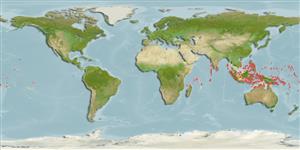
Indo-West Pacific: widespread; from the Red Sea to South Africa; from Sri Lanka, the east and west coast of Australia, Indonesia, southern Japan and east to the Marshall Islands, New Caledonia and Fiji.
Taille / Poids / Âge
Maturité: Lm ? range ? - ? cm
Max length : 7.3 cm TL mâle / non sexé; (Ref. 11441)
Description synthétique
Clés d'identification | Morphologie | Morphométrie
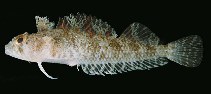
Épines dorsales (Total) : 18 - 19; Rayons mous dorsaux (Total) : 10 - 11; Épines anales: 2; Rayons mous anaux: 20 - 21. This species is distinguished by the following characters: D IV + XIV-XV + 10-11 (IV+XV+11); A II, 20-21 (21), spine length half of the rays; pectoral rays 16, dorsalmost 2-3 and ventral most 7 simple, remainder branched once; pelvic rays bound together by membrane for less than one-fourth of length of shorter ray; lateral line pored scales 21-24 (22), terminates between 2nd and 3rd dorsal fins; notched scales and 14-19 (16); total lateral scales 32-35 (34); dentary pores 5-6 + 1 + 5-6; orbital and nasal cirri palmate and about as large as pupil diameter; dorsal fin also with cirri at tips of spines; head 2.9-3.6 (3.3) in SL, eye 3.0-3.9 (3.3), maxilla 2.3-3.0 (2.6) and snout 3.3-4.9 (3.8) in head length (Ref. 88983).
Body shape (shape guide): elongated; Cross section: oval.
Adults inhabit coral or rock, often under ledges, on clear lagoon and seaward reefs (Ref. 13227). Eggs are hemispherical and covered with numerous sticky threads that anchor them in the algae on the nesting sites (Ref. 240). Larvae are planktonic which occur primarily in shallow, nearshore waters (Ref. 94114).
Cycle de vie et comportement reproducteur
Maturité | Reproduction | Frai | Œufs | Fécondité | Larves
Holleman, W. and S.V. Bogorodsky, 2012. A review of the blennioid fish family Tripterygiidae (Perciformes) in the Red Sea, with description of Enneapterygius qirmiz, and reinstatement of Enneapterygius altipinnis Clark, 1980. Zootaxa 3152:36-60. (Ref. 88983)
Statut dans la liste rouge de l'IUCN (Ref. 130435: Version 2025-2 (Global))
Menace pour l'homme
Harmless
Utilisations par l'homme
Pêcheries: sans intérêt
Outils
Articles particuliers
Télécharger en XML
Sources Internet
Estimations basées sur des modèles
Température préférée (Réf.
123201): 27.6 - 29.3, mean 28.7 °C (based on 1848 cells).
Indice de diversité phylogénétique (Réf.
82804): PD
50 = 0.5625 [Uniqueness, from 0.5 = low to 2.0 = high].
Bayesian length-weight: a=0.00617 (0.00290 - 0.01310), b=3.04 (2.86 - 3.22), in cm total length, based on LWR estimates for this (Sub)family-body shape (Ref.
93245).
Niveau trophique (Réf.
69278): 3.2 ±0.4 se; based on size and trophs of closest relatives
Résilience (Réf.
120179): Haut, temps minimum de doublement de population inférieur à 15 mois (Preliminary K or Fecundity.).
Vulnérabilité de la pêche (Ref.
59153): Low vulnerability (10 of 100).
🛈
Nutriments (Ref.
124155): Calcium = 246 [122, 544] mg/100g; Iron = 1.36 [0.67, 2.48] mg/100g; Protein = 18.4 [17.2, 19.7] %; Omega3 = 0.103 [0.046, 0.236] g/100g; Selenium = 43.2 [15.9, 109.2] μg/100g; VitaminA = 61.1 [15.9, 225.8] μg/100g; Zinc = 2.89 [1.69, 4.58] mg/100g (wet weight);