Окружающая среда: среда / климатическая зона / пределы глубины / диапазон распространения
экология
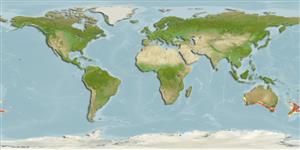
морской демерсальный; пределы глубины 50 - 750 m (Ref. 6390). Subtropical; 26°S - 55°S
Southwest Pacific: Australia and New Zealand. Two forms of ocean perch are recognized in waters off New South Wales, Australia (Ref. 6390). They are referred to as 'inshore' and 'offshore' forms based on their preferred depth ranges (Ref. 6390).
A closely related species, Helicolenus barathri, is known from New Zealand and its distribution may also include southern Australian waters (Ref. 30468, 30471).
Размер / Вес / Возраст
половая зрелость: Lm ? range ? - ? cm
Max length : 47.0 cm TL самец/пол неопределен; (Ref. 9563); наибольший вес (опубликованные данные): 1.4 kg (Ref. 30476); наибольший возраст (опубликованны данные): 42 годы (Ref. 30476)
Краткое описание
определительные ключи | морфология | морфометрия
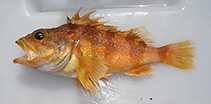
колючие лучи спинного плавника (общее число) : 12; членистые (мягкие) лучи спинного плавника (общее число) : 11 - 12; колючие лучи анального плавника: 3; членистые (мягкие) лучи анального плавника: 5; позвонки: 25.
Body shape (shape guide): fusiform / normal.
Occur on the continental shelf and slope (Ref. 9563). Two forms exist in New South Wales, Australia. The inshore form is dominant in depths less than 300 m and the offshore form is most common in deeper waters (Ref. 30468). Juveniles of both forms are caught near the edge of the continental shelf by fishers targeting royal red prawns (Haliporoides sibogae) in Australia, but their full distribution is unknown (Ref. 6390). Reproduction in ocean perch is distinctive in that fertilization is internal (Ref. 6390, 34817). Feed on squid, shrimps and fish (Ref. 6390). Head and dorsal-fin spines are venomous (Ref. 33616). Sold whole and chilled on the domestic fresh fish markets (Ref. 6390).
Larvae stay within the female fish until they are approximately 1 mm long before they are released into the water (Ref. 6390).
In Australia, the inshore and offshore forms of ocean perch begin mating at different times and there is a difference in the length of their larval development prior to release (Ref. 30468).
Kailola, P.J., M.J. Williams, P.C. Stewart, R.E. Reichelt, A. McNee and C. Grieve, 1993. Australian fisheries resources. Bureau of Resource Sciences, Canberra, Australia. 422 p. (Ref. 6390)
Статус Красного Списка МСОП (Ref. 130435: Version 2025-2 (Global))
Использование человеком
рыболовство: коммерческий
дополнительная информация
инструменты
Специальные отчеты
Скачать в формате XML
ресурсы в Интернет
Оценки, основанные на моделях
Предпочтительная температура (ссылка
123201): 10.5 - 16.6, mean 13 °C (based on 72 cells).
Индекс филогенетического разнообразия (ссылка
82804): PD
50 = 0.5020 [Uniqueness, from 0.5 = low to 2.0 = high].
Bayesian length-weight: a=0.01585 (0.00947 - 0.02651), b=3.12 (2.97 - 3.27), in cm total length, based on LWR estimates for this species & (Sub)family-body (Ref.
93245).
Трофический уровень (ссылка
69278): 3.9 ±0.6 se; based on diet studies.
устойчивость к внешним воздействиям (ссылка
120179): низкий, минимальное время удвоения популяции 4.5-14 лет (K=0.11-0.12; tmax=42; Fec=150,000).
Уязвимость рыбной ловли (Ref.
59153): High vulnerability (64 of 100).
🛈
Питательные вещества (Ref.
124155): Calcium = 59 [20, 156] mg/100g; Iron = 1.05 [0.46, 2.21] mg/100g; Protein = 17.9 [16.3, 19.7] %; Omega3 = 0.643 [0.281, 1.641] g/100g; Selenium = 42.5 [18.9, 115.9] μg/100g; VitaminA = 24.5 [8.1, 78.9] μg/100g; Zinc = 0.671 [0.378, 1.054] mg/100g (wet weight);