>
Cichliformes (Cichlids, convict blennies) >
Cichlidae (Cichlids) > Pseudocrenilabrinae
Etymology: Oreochromis: Latin, aurum = gold + Greek, chromis = a fish, perhaps a perch (Ref. 45335); esculentus: Esculentus (latin) = edible (Ref. 27292). "The specific name esculenta is suggested, so as to express the fact that this is the important edible commercial species of Lake Victoria." (Ref. 27292, 55055).
Môi trường: môi trường / vùng khí hậu / Mức độ sâu / phạm vi phân phối
Sinh thái học
; nước ngọt sống nổi và đáy; mức độ sâu 0 - 50 m (Ref. 34291), usually ? - 20 m (Ref. 34290). Tropical; 23°C - 28°C (Ref. 3)
Africa: Lake Victoria, Lake Nabugabo, Lakes Kyoga and Kwania, the Victoria Nile above the Murchison Falls, Malawa River and Lake Gangu (Ref. 5166, 34290) in Tanzania, Uganda and Kenya (Ref. 3); but now extirpated from the main lake body and the only natural remaining populations are those of satellite lakes (Ref. 118638). The species has been introduced into dams of the Lake Victoria catchment, as well as the Pangani catchment, Zigi River, Malagarazi River, Lake Rukwa, Wami River and the central Tanzania lakes surrounding Dodoma and Tabora (Ref. 118630, 118638). Introductions in the Akagera lakes in Rwanda (Ref. 1739, 54979) seem to have been based on erroneous tilapia identifications (Ref. 46152).
Chiều dài lúc trưởng thành đầu tiên / Bộ gần gũi / Khối lượng (Trọng lượng) / Tuổi
Chín muồi sinh dục: Lm 24.9, range 17 - 27 cm
Max length : 50.0 cm SL con đực/không giới tính; (Ref. 2); common length : 31.0 cm SL con đực/không giới tính; (Ref. 34290); Khối lượng cực đại được công bố: 2.5 kg (Ref. 2); Tuổi cực đại được báo cáo: 10 các năm (Ref. 2)
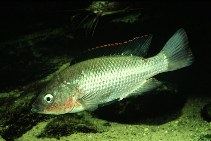
Các tia vây lưng cứng (tổng cộng) : 16 - 18; Các vây lưng mềm (tổng cộng) : 10 - 11; Tia cứng vây hậu môn: 3; Tia mềm vây hậu môn: 10 - 12; Động vật có xương sống: 30 - 31. Diagnosis: A large bodied tilapia with a small rounded head, short snout, forward-facing mouth, deep body, relatively small eye for the body size, and generally lacking any dark stripes or blotches (Ref. 118638). Females and non-territorial males typically pale grey, white ventrally; males are typically darker, especially in the head/dorsal region; breeding males have a reddish-pink head and flank, dark fins with red/pink dorsal margins, and red/pink caudal region (Ref. 118638). In contrast to Oreochromis rukwaensis, mature males of O. esculentus do not show enlarged jaws (Ref. 27292). Oreochromis esculentus differs from O. niloticus as follows: no vertical stripes on the caudal fin; lower numbers of soft dorsal rays and therefore of total dorsal rays; lower modal number of lower gill-rakers; finer teeth in jaws and pharynx; a longer lower pharyngeal bone, 33.0-35.5% length of head; caudal peduncle as long as or, usually, longer than deep; O. niloticus, in common with many other species, is often preserved with three or four midlateral spots and another on the top of the caudal peduncle, a pattern not found in O. esculentus; and male genital papilla opening between a pair of often spongy lobes, vs. papilla conical or with a slight distal notch in O. niloticus (Ref. 2).
Body shape (shape guide): fusiform / normal.
Occasionally forms schools (Ref. 2, 363, 36900), mainly diurnal (Ref. 2). Tolerant of low oxygen concentrations, less than 1 ppm, and high levels of carbon dioxide (Ref. 3, 52016). A plankton-feeder using the mucus-trap mechanism combined with the combing action of the pharyngeal teeth (Ref. 2); the species is non-selective, in the sense that all organisms of a size capable of being retained by these means are passed into the stomach, but it is selective in that the schools follow concentrations of diatoms in the lake (Ref. 2). Food consist almost entirely of phytoplankton (Ref. 3, 6316), mainly diatoms (Ref. 4903, 30832, 34291), but also higher plants, insects and their larvae, crustaceans and worms like Tubifex (Ref. 27292); insect larvae and planktonic crustaceans occur less frequently although they may contribute to the diet of young fishes (Ref. 4903, 34291). A maternal mouthbrooder (Ref. 363, 4903, 12468, 27292, 34291, 54840, 118638); males make simple nests in shallow water (Ref. 118638). Ecologically, an offshore-living plankton feeder, which complemented the more inshore-living Oreochromis variabilis in the original ecosystem of Lake Victoria; these niches are now filled by the introduced Oreochromis niloticus and O. leucostictus respectively (Ref. 118638). Was a major component of the fisheries catch in Lake Victoria; supports artisanal fisheries in satellite lakes of Lake Victoria and forms a large part of the catch in Lake Rukwa, Nyumba ya Mungu and the central Tanzania lakes (Ref. 118638). Excellent taste, firm meat and suitable for sundrying (Ref. 54860). IUCN conservation status is critically endangered (Ref. 118638).
Reproduction probably triggered by the rains (Ref. 2771), with the time of maximum spawning activity coinciding with the wettest months of the year (Ref. 363). Males form a crater-like spawning nest without a distinct wall (Ref. 27292). The pit is about 30cm in diameter and 10cm deep, and is probably made in the early morning (Ref. 27292). Ovaries show that a female may have a succession of three or more broods in a spawning period; brooding females often shelter in weed beds and swampy places (Ref. 2, 363). Males defend their breeding territory (Ref. 2) for weeks or on and off for several months, while females only make short visits to the spawning grounds and leave the territory immediately after spawning (Ref. 363). Males eat little while actively guarding the nest (Ref. 363). Papyrus swamp channels (Ref. 363, 34921, 55020) and beaches with weed grown swamps (Ref. 34921) function as nursery areas. Young become independent at a length of about 1.5cm (Ref. 2, 363)by which size the yolk sac is occluded and they have strated to feed (Ref. 363), and at about 12cm TL they move from the nursery areas to the open water (Ref. 2).
Trewavas, E., 1983. Tilapiine fishes of the genera Sarotherodon, Oreochromis and Danakilia. British Mus. Nat. Hist., London, UK. 583 p. (Ref. 2)
Tình trạng Sách đỏ IUCN (Ref. 130435: Version 2025-2 (Global))
Mối đe dọa đối với con người
Potential pest (Ref. 13364)
Sử dụng của con người
Các nghề cá: tính thương mại; Nuôi trồng thủy sản: thực nghiệm
Các công cụ
Báo cáo đặc biệt
Tải xuống XML
Các nguồn internet
Ước tính dựa trên mô hình
Chỉ số đa dạng phát sinh loài (Tài liệu tham khảo
82804): PD
50 = 0.5000 [Uniqueness, from 0.5 = low to 2.0 = high].
Bayesian length-weight: a=0.01413 (0.00822 - 0.02428), b=3.02 (2.88 - 3.16), in cm total length, based on LWR estimates for this species & Genus-body shape (Ref.
93245).
Mức dinh dưỡng (Tài liệu tham khảo
69278): 2.5 ±0.17 se; based on food items.
Thích nghi nhanh (Tài liệu tham khảo
120179): Trung bình, thời gian nhân đôi của chủng quần tối thiểu là 1.4 - 4.4 năm (tmax=10).
Sự dễ bị tổn thương của nghề đánh cá (Ref.
59153): Low to moderate vulnerability (31 of 100).
🛈