Umwelt: Milieu / Klimazone / Tiefenbereich / Verbreitungsgebiet
Ökologie
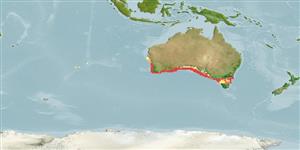
seewasser demersal; tiefenbereich 70 - 490 m (Ref. 6390). Subtropical; 27°S - 41°S
Indo-Pacific: endemic to the southern waters of Australia, from Marrawah in northwestern Tasmania to latitude 27°S off Western Australia. This species has been confused with Platycephalus speculator until recently.
Länge bei der ersten Reifung / Größe / Gewicht / Alter
Geschlechtsreife: Lm 40.0, range 45 - ? cm
Deprecated: number_format(): Passing null to parameter #1 ($num) of type float is deprecated in /var/www/html/includes/common.lib.php on line 1833
Max length : 70.0 cm TL Männchen/unbestimmt; (Ref. 6390); 94.0 cm TL (female); max. veröff. Gewicht: 0.00 g; max. veröff. Alter: 20 Jahre (Ref. 6390)
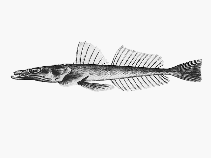
Occurs on the continental shelf and upper slope (Ref. 9563). Feeds primarily on fish, crustaceans and squid (Ref. 6390). Probably forms aggregations by sex (Ref. 27192). Sold as fresh, chilled, or frozen fillets in the domestic market.
Paxton, J.R., D.F. Hoese, G.R. Allen and J.E. Hanley, 1989. Pisces. Petromyzontidae to Carangidae. Zoological Catalogue of Australia, Vol. 7. Australian Government Publishing Service, Canberra, 665 p. (Ref. 7300)
IUCN Rote Liste Status (Ref. 130435: Version 2025-2 (Global))
Bedrohung für Menschen
Harmless
Nutzung durch Menschen
Fischereien: kommerziell
Tools
Zusatzinformationen
Download XML
Internet Quellen
Schätzungen auf der Grundlage von Modellen
Bevorzugte Temperatur (Ref.
123201): 12.7 - 15.8, mean 14.4 °C (based on 15 cells).
Phylogenetischer Diversitätsindex (Ref.
82804): PD
50 = 0.5000 [Uniqueness, from 0.5 = low to 2.0 = high].
Bayesian length-weight: a=0.00427 (0.00219 - 0.00832), b=3.11 (2.94 - 3.28), in cm total length, based on LWR estimates for this (Sub)family-body shape (Ref.
93245).
Trophische Ebene (Ref.
69278): 4.0 ±0.59 se; based on food items.
Widerstandsfähigkeit (Ref.
120179): niedrig, Verdopplung der Population dauert 4,5 - 14 Jahre. (tm=4-6; tmax=20).
Anfälligkeit der Fischerei (Ref.
59153): Moderate to high vulnerability (53 of 100).
🛈