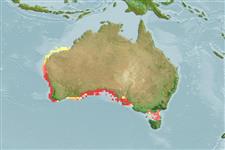
Miljö: miljö / Klimatzon / djupintervall / distributionsområde
Ekologi
marina revassocierade; djupintervall 1 - 35 m (Ref. 9563). Subtropical
Eastern Indian Ocean: southern Western Australia and South Australia.
Storlek / Vikt / Ålder
Könsmognad: Lm ? range ? - ? cm
Max length : 10.0 cm TL hane/ej könsbestämd; (Ref. 9563)
Kort beskrivning
Bestämningsnycklar | Morfologi | Morfometri
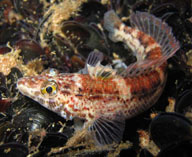
Taggstrålar i ryggfenan (totalt) : 5; Mjukstrålar i ryggfenan (totalt) : 21 - 22; Taggstrålar i analfenan: 1; Mjukstrålar i analfenan: 17 - 18. This species is characterized by the following: D V,21-22 (rarely 21); A I,17-18 (rarely 17); 13-15 pectoral rays; 47-53 lateral-line scales; about 3 + 8 gill rakers; 3-4 predorsal scales, ending in a median naked area on nape with rest of nape scaled, the scales extending into posterior interorbital space and continuing in a single row to front of interorbital; ctenoid scales on nape and cheek; front of lower jaw with 10 canine teeth; with palatine teeth; upper edge of subopercle with a prominent sharp spine; vertical edge of preopercle serrate to irregular; body depth 4.45-5.35 in SL (18.7-22.6% SL); middle dorsal spine longest, 7.05-8.9% SL; truncate to slightly rounded caudal fin, 19.2-21.3% SL; membrane from last dorsal spine joined to base of first soft ray; whitish body with a straight to wavy black stripe from behind eye to upper base of caudal fin (stripe may be broken into blotches, especially on head); ventral half of body with a series of 10 dark bars; a broad median brown band on upper lip and two spots on side of lip; a long dark brown streak on side of lower lip; a large black spot basally in dorsal fin between spines II and V; soft portion of dorsal fin is pale with a small blackish spot at base of most rays, and 1-2 outer rows of small black spots on membranes; pale anal fin with a row of faint blackish spots at base of most rays and a middle row of small dark spots; pale caudal fin with a dusky lower margin (Ref. 57562).
Body shape (shape guide): elongated.
Found on coastal reefs (Ref. 9563). A small territorial fish found in protected sandy and muddy areas near reefs and rocky outcrops from the shallows to depths of just over 35 m (Ref. 33839).
Livscykel och parningsbeteende
Könsmognad | Reproduktion | Lek | Ägg | Fekunditet | Larver
May, J.L. and J.G.H. Maxwell, 1986. Trawl fish from temperate waters of Australia. CSIRO Division of Fisheries Research, Tasmania. 492 p. (Ref. 9563)
Status på IUCN:s rödlista (Ref. 130435: Version 2025-2 (Global))
Hot mot människor
Harmless
Mänskliga användningsområden
Verktyg
Särskilda rapporter
Ladda ner XML
Internet-källor
Uppskattningar baserade på modeller
Önskad temperatur (Ref.
123201): 15.2 - 22.8, mean 17.7 °C (based on 212 cells).
Index för fylogenetisk mångfald (Ref.
82804): PD
50 = 0.5000 [Uniqueness, from 0.5 = low to 2.0 = high].
Bayesian length-weight: a=0.00692 (0.00314 - 0.01524), b=3.06 (2.88 - 3.24), in cm total length, based on LWR estimates for this Genus-body shape (Ref.
93245).
Trofisk nivå (Ref.
69278): 3.4 ±0.4 se; based on size and trophs of closest relatives
Resiliens (Ref.
120179): Hög, lägsta populationsfördubblingstid mindre än 15 månader (Preliminary K or Fecundity.).
Sårbarhet i fisket (Ref.
59153): Low vulnerability (10 of 100).
🛈
Näringsämnen (Ref.
124155): Calcium = 97 [41, 205] mg/100g; Iron = 0.873 [0.457, 1.605] mg/100g; Protein = 18.7 [16.4, 20.8] %; Omega3 = 0.164 [0.084, 0.313] g/100g; Selenium = 13.9 [5.5, 32.3] μg/100g; VitaminA = 65.3 [18.2, 241.9] μg/100g; Zinc = 1.31 [0.77, 2.08] mg/100g (wet weight);